Angel Acres Eggs Are Available Through Nourish Food Club
The original corn- and soy-free, Low PUFA pasture-raised eggs from our farm Angel Acres, now conveniently shipped nationwide through our farm cooperative: Nourish Food Club.
- - Corn & Soy-Free
- - Pasture-Raised
- - Drug Free
- - Pesticide Free
Choose between one-time purchases or recurring deliveries through our Angel Acres Egg Club subscription program.
Why Are Angel Acres Eggs Sold Through Nourish Food Club?

Angel Acres began as a small regenerative farm built from scratch by two sisters with no prior farming experience who were deeply frustrated with the conventional food system: a system where food is treated like a commodity, metabolism-suppressing polyunsaturated fat (PUFA) levels in the food continue to rise, and families are left guessing what they can truly trust.
So the journey started with just 8 backyard chickens and one simple question: what are animals actually being fed these days?
When we learned that even pasture-raised chickens still rely heavily on chicken feed (and that most feeds on the market are built around corn, soy, seed oils, and industrial byproducts), we started questioning the eggs available to us.
We couldn’t find eggs that aligned with the standards we were personally looking for or felt excited to feed our own families.

You are what you eat… so what chickens eat doesn’t just affect the chicken. It changes the nutritional composition of the egg itself. As poultry diets have become increasingly higher in PUFAs, modern eggs now contain far more PUFAs than eggs historically did.
So we set out to create something different, and something we couldn't find elsewhere: a low PUFA egg.
This required hand-mixing our own custom corn- and soy-free chicken feed ration in the farm garage by Farmer Ash (one of the sisters), a feed formulation that took years of research, testing, and refinement to perfect.
And independent fatty acid testing confirmed something pretty incredible: our eggs contained over 70% less linoleic acid (an omega-6 PUFA found in seed oils) compared to pasture-raised eggs from hens fed conventional corn- and soy-based feed. We did it!
What started as a small backyard experiment had turned into something we couldn’t find elsewhere: a genuinely low PUFA egg.
So Angel Acres eggs aren’t just pasture-raised eggs.
They are eggs intentionally produced through thoughtful feed formulation and regenerative farming practices.
From Angel Acres Farm → Nourish Food Club
As demand for our low PUFA, corn- and soy-free eggs continued growing, we realized that no single farm could realistically produce everything families were looking for on its own.
Rather than industrialize one massive farm, we chose a different path.
Nourish Food Club was created to partner with other small regenerative farms that shared our values around animal welfare, feed quality, soil health, and nutrient density. This allowed us to expand access to these foods while still supporting smaller farming operations and maintaining the standards we cared deeply about.
Today, Angel Acres remains the original farm and foundation of the mission, while Nourish Food Club serves as the broader food platform making Angel Acres eggs and other clean farm-fresh foods available to families nationwide.
What are Angel Acres eggs?
Unlike many conventional or even pasture-raised eggs, we believe what hens are fed matters just as much as access to pasture because feed directly changes the nutritional composition of the final egg.
That’s why our hens not only have access to fresh grasses, insects, sunlight, and natural forage outdoors, but are also fed our carefully formulated low PUFA, corn- and soy-free feed designed around healthier fats and greater nutrient density.
Angel Acres eggs are now produced through a trusted network of small regenerative farms we personally know and work closely with. Every farm follows our strict production standards and receives the same custom-formulated feed to produce the healthiest, cleanest, and best-tasting eggs you can find, conveniently delivered directly to your door.

What makes Angel Acres Eggs different?
- - Corn-, Soy-, and Flax-Free Feed
- - Low in PUFAs (the unstable fats found in seed oils)
- - Pesticide-Free
- - Drug-Free (no vaccines, antibiotics, hormones, or other pharmaceuticals)
- - Low in phytoestrogens (hormone disruptors)
- - Mobile Pasture-Raised Hens
- - Raised on small regenerative farms
At the end of the day, our mission is simple: to produce clean, nutrient-dense, low PUFA eggs with exceptional flavor and healthier fats you can truly feel good about feeding your family.

But our eggs aren't just lower in PUFAs... they are eggs people can finally tolerate!
We consistently hear from customers who avoided eggs for years, and found they could tolerate our corn- and soy-free eggs.
Why?
Because what the chicken eats… you eat.
Removing corn and soy doesn’t just change the fatty acids.
It can change the taste, egg digestibility, allergenicity level, and how people feel after eating eggs.
corn- and soy-free, farm-fresh eggs
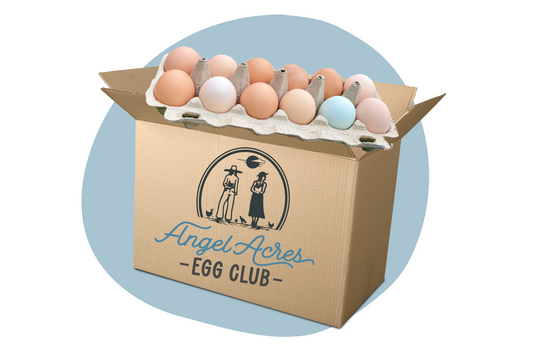
Low PUFA
Corn & Soy Free
Mobile Pasture-Raised
Corn- & Soy-Free Egg Box Corn- & Soy-Free Egg Box
Low PUFA
Corn & Soy Free
Mobile Pasture-Raised
Heritage Petite Eggs Heritage Petite Eggs
Low PUFA
Corn & Soy Free
Mobile Pasture-Raised

Frequently Asked Questions
Where can I buy Angel Acres eggs?
Angel Acres are now sold exclusively through Nourish Food Club and are delivered nationwide to our food club members.
Nourish Food Club is a Private Member Association connecting you directly with traditional, unaltered, regeneratively raised farm-fresh foods that truly nourish your body and support optimal health.
Why is there a waitlist and why are your eggs sold out?
Some weeks we are sold out! Because we’re not building an industrial egg factory. We grow slowly and intentionally, expanding through a trusted network of small regenerative farms. No shortcuts. No confinement. No compromise.
To ensure true farm freshness, our Egg Club runs on a 7-day harvest cycle. We restock weekly and our subscribers get first dibs. Next in line? The waitlist! Either check back each Friday or join the Waitlist below!
Join the waitlist here to be first notified when eggs restock
What’s the difference between Angel Acres and Nourish Food Club?
Angel Acres is the original farm where we began producing the first low PUFA, corn- and soy-free eggs. From that foundation, we expanded into Nourish Food Club — a broader food platform built to connect families with nutrient-dense, farm-fresh foods from regenerative farms we trust. We have slowly added more small regenerative farmers in our network that we work with directly.
Today, Nourish Food Club offers a wide variety of clean foods beyond eggs, including corn- and soy-free chicken and pork, raw A2 cheese, sourdough bread, 100% grass-fed beef and lamb, clean seasonal produce, and more, through our partnership of small regenerative farms.
Clean, healthy farm-fresh food, all in one place! Your virtual farmstand.
What is Angel Acres Egg Club?
Our egg boxes are available as either a one-time purchase or through our subscription program. Angel Acres Egg Club is our egg subscription program connecting families with low PUFA corn- and soy-free pasture-raised eggs from our network of small regenerative farms. Subscribers receive guaranteed egg deliveries directly to their home at their preferred frequency, so they never have to worry about limited supply, grocery store shortages, or joining a waitlist.
Because demand for our eggs is often very high, subscribing when spots are available is the best way to secure consistent access to clean, nutrient-dense eggs you can truly feel good about feeding your family, conveniently delivered right to your door.
Angel Acres Egg Club was created to make healthy egg sourcing simple, convenient, and reliable for families who care deeply about food quality and transparency.
Where were your fatty acid test results performed?
Decades of research spanning more than 70 years along with our own repeated fatty acid testing make one thing very clear: PUFAs in = PUFAs out.
Meaning, when chickens consume more polyunsaturated fats (PUFAs) in their diet, those same fats are deposited directly into the egg yolk. This relationship is well established in the scientific literature. Diets high in soy, corn, distillers grains, and other PUFA-rich byproducts consistently produce eggs higher in total PUFAs and linoleic acid (an omega-6 PUFA).While developing our custom corn- and soy-free, low-PUFA feed, we have conducted repeated fatty acid analyses to confirm this effect firsthand (and to make sure my feed ration was working!).
Our eggs have been lab-tested multiple times since I started formulating my own feed in my garage in 2021 at Michigan State University, consistently showing a significantly lower PUFA and linoleic acid content compared to conventional and pasture-raised eggs fed standard diets. The results have consistently shown similar results.
Here is a link to our May 2025 testing, which showed 5.5% Linoleic Acid and 7.5% total Omega 6. (Very low PUFA
Here is a link to the fatty acid test result listed as Percentage of Fatty Acids from fall of 2024 comparing our eggs to Organic Vial Farms and Organic Cage Free.
With a 6.122% Linoleic Acid fatty acid percentage, for 2 eggs that is 10 grams of fat * .06122 = only 0.6 grams Linoleic Acid per 2 of our eggs. Low PUFA eggs! Compare that to 10 * .22894 = 2.3 grams Linoleic Acid per 2 eggs.
73% less Linoleic Acid!
Repeated exposure, day after day, this builds up inside of you and negatively impacts metabolism, gut health, and overall health.
Are your eggs 100% grass-fed?
The reality is that there are no 100% grass-fed chickens since chickens are omnivores, not vegetarians.
Many people assume chickens can thrive on grass and bugs alone. In reality, that’s neither accurate nor humane. Chickens are omnivores with significant energy and protein requirements, especially laying hens. Grass and insects cannot reliably meet those needs year-round. Chickens have been domesticated for roughly 8,000 years and have always relied on humans for supplemental grain feeding alongside foraging. Expecting hens to live solely on pasture leads to nutrient deficiencies, poor health, and reduced welfare. Pasture is an important addition to a chicken’s diet, but intentional supplemental feed is essential for healthy birds and high-quality eggs.
So all chickens (even pasture-raised) require a supplemental feed.
The problem is most modern feeds are high in PUFAs due to soy and corn-byproducts (because that is what the system is designed for). So we rolled up our sleeves and designed out own feed!
Chickens are monogastric (single stomached) animals (like us), meaning they cannot get their required protein intake from grass alone (unlike ruminants such as cows). So while our chickens consume grass and bugs on pasture, they are supplemented with our custom-made corn- and soy-free feed.
What does corn- and soy- free eggs mean?
All chickens (even pasture-raised ones) require supplemental feed, which can make up 70–90% of their diet. What they eat has a huge impact on the quality of the eggs they produce.
Corn and soy free means that the feed does not contain corn or soy. Typical commercial chicken feeds, even for pasture-raised hens, often include soybean meal, soy oil, “vegetable oil,” and corn-based ingredients like dried distillers grains. These ingredients are highly unsaturated and loaded with plant-based polyunsaturated fats (PUFAs), especially omega-6 linoleic acid (LA).
Here’s the key point: when a chicken eats more PUFAs, more PUFAs show up in her eggs. That’s a problem because most of us are already overexposed to these unstable fats from vegetable oils and conventional meats, something our ancestors never dealt with in such high quantities.
Unfortunately, many brands advertising “corn and soy free” eggs stop at removing corn and soy... but what do they replace them with?
Often, the substitutes are other high-PUFA seeds and oils, which doesn’t solve the PUFA problem... it just repackages it.
At Nourish and Angel Acres Egg Club we do things differently. We custom formulate our feed to be corn- and soy-free and low in PUFAs, producing eggs with 73% less linoleic acid than conventional eggs.
We not only formulate our own feed, but we custom make it in house so that we are responsible for sourcing all ingredients, milling, and delivery to partner farms.
When done the right way, corn and soy free eggs can lead to:
- Less unstable fats in your diet
- Lower oxidation and free radical formation
- Fewer hormone-disrupting compounds
- Eggs that are easier to digest
When done right, “corn and soy free” isn’t just an allergen label, it’s a way to restore eggs to the nutrient profile nature intended.
Want to dig deeper? Check out my YouTube video where I explore “Is Corn- and Soy-Free a Scam?”
> Tune in here
How are these eggs different than pasture-raised eggs sold at the store?
Not all “pasture-raised” eggs are created equal.
Most grocery-store pasture-raised eggs come from large industrial systems, often tens of thousands of hens housed in stationary barns with small outdoor access doors. While these systems are an improvement over cages, the scale is still industrial, and the feeding model is usually the same as conventional production.
And that’s the part most people miss: even pasture-raised hens get 70–90% of their calories from supplemental feed.
Pasture access matters, but feed matters just as much, because the fats and compounds in the feed become the fats and compounds in the egg.
The reality is that nearly all chickens in the U.S. are fed corn- and soy-based feed, which is high in omega-6 polyunsaturated fats (PUFAs). This is one of the biggest reasons modern eggs contain far more linoleic acid than eggs historically did.
That’s why Angel Acres took a completely different approach.
Instead of relying on standard off-the-shelf feed, we developed our own one-of-a-kind corn- and soy-free feed, intentionally formulated to be low in PUFAs, more aligned with how chickens were traditionally raised.
And the results are measurable:
Independent fatty acid testing shows that Angel Acres eggs contain 73% less omega-6 linoleic acid compared to leading store-bought pasture-raised eggs.
Angel Acres eggs aren’t just a label, they reflect a fundamentally different system:
small regenerative farms, real pasture rotation, and feed designed with metabolic integrity in mind.
angel acres eggs, now sold through nourish food club
Angel Acres eggs are now available through Nourish Food Club
If you’ve been searching for:
- - Angel Acres eggs
- - Corn-free eggs
- - Soy-free eggs
- - Flax-free eggs
- - Low PUFA eggs
- - Truly regenerative pasture-raised eggs
You’re in the right place.