Corn- and Soy-Free Chicken
Pasture-raised chicken from regeneratively and humanely raised animals, drug-free and crafted to be low in PUFAs.

- Low Ps™
- Corn & Soy Free
- Mobile Pasture-Raised
- Drug-Free
- Seed to Fork


- Low Ps™
- Corn & Soy Free
- Mobile Pasture-Raised
- Drug-Free
- Seed to Fork
-
Low PUFA
Corn & Soy Free
Mobile Pasture-Raised
Corn- & Soy-Free Ground Chicken Corn- & Soy-Free Ground Chicken
1 lb
Regular price $17.99$17.99 Regular priceUnit price per$14.38Sale price -
Low PUFA
Corn & Soy Free
Mobile Pasture-Raised
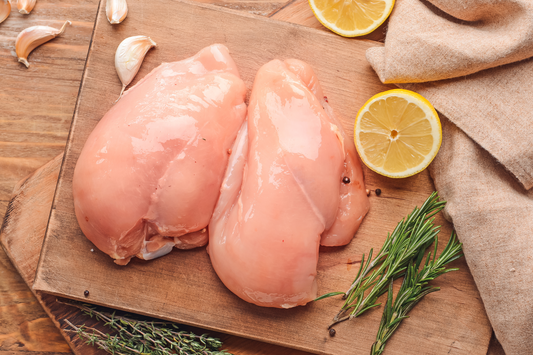
Corn- & Soy-Free Chicken Breast Corn- & Soy-Free Chicken Breast
-
Low PUFA
Corn & Soy Free
Mobile Pasture-Raised
Corn- & Soy-Free Chicken Thighs Corn- & Soy-Free Chicken Thighs
-
Low PUFA
Corn & Soy Free
Mobile Pasture-Raised
Corn- & Soy-Free Chicken Hot Dogs Corn- & Soy-Free Chicken Hot Dogs
12 oz avg.
Regular price $12.99$12.99 Regular priceUnit price per -
Low PUFA
Corn & Soy Free
Mobile Pasture-Raised
Corn- & Soy-Free Chicken Sausages Corn- & Soy-Free Chicken Sausages
1 lb avg.
Regular price $17.89$17.89 Regular priceUnit price per$14.38Sale priceSold Out -
Low PUFA
Corn & Soy Free
Mobile Pasture-Raised
Corn- & Soy-Free Chicken Bratwursts Corn- & Soy-Free Chicken Bratwursts
1 lb avg.
Regular price $16.89$16.89 Regular priceUnit price per$14.38Sale price -
Low PUFA
Corn & Soy Free
Mobile Pasture-Raised
Corn- & Soy-Free Chicken Breast - Bone-In & Skin-On Corn- & Soy-Free Chicken Breast - Bone-In & Skin-On
1 $43.70 $38.48Sale -
Low PUFA
Corn & Soy Free
Mobile Pasture-Raised
Corn- & Soy-Free Chicken Thighs - Bone-In & Skin-On Corn- & Soy-Free Chicken Thighs - Bone-In & Skin-On
Sold Out -
Low PUFA
Corn & Soy Free
Mobile Pasture-Raised
Corn- & Soy-Free Whole Chicken Corn- & Soy-Free Whole Chicken
Sold Out -
Mobile Pasture-Raised
Collagen Rich
Canned in Glass
Chicken Bone Broth Chicken Bone Broth
1 Quart
Regular price $21.01$21.01 Regular priceUnit price per -
Low PUFA
Corn & Soy Free
Mobile Pasture-Raised
Corn- & Soy-Free Chicken Wings Corn- & Soy-Free Chicken Wings
1-1.5 lbs
1 $15.79 -
Low PUFA
Corn & Soy Free
Mobile Pasture-Raised
Corn- & Soy-Free Chicken Party Wings Corn- & Soy-Free Chicken Party Wings
.75-1.25 lbs
Regular price $16.79$16.79 Regular priceUnit price per -
Low PUFA
Corn & Soy Free
Mobile Pasture-Raised
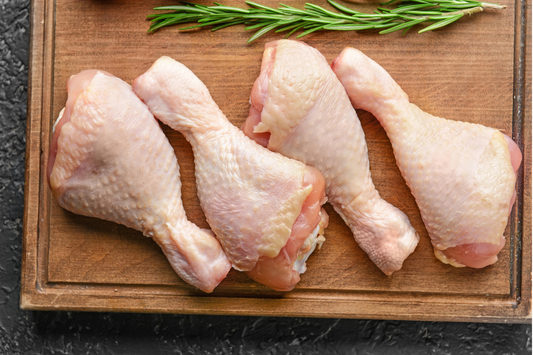
Corn- & Soy-Free Chicken Drumsticks Corn- & Soy-Free Chicken Drumsticks
1-1.5 lbs
1 $14.30 -
Low PUFA
Corn & Soy Free
Mobile Pasture-Raised
Corn- & Soy-Free Chicken Hearts Corn- & Soy-Free Chicken Hearts
Sold Out -
Low PUFA
Corn & Soy Free
Mobile Pasture-Raised
Corn- & Soy-Free Chicken Liver Corn- & Soy-Free Chicken Liver
1 lb
Regular price $11.79$11.79 Regular priceUnit price per -
Low PUFA
Corn & Soy Free
Mobile Pasture-Raised
Corn- & Soy-Free Chicken Gizzards Corn- & Soy-Free Chicken Gizzards
1 lb
1 $8.66 -
Low PUFA
Corn & Soy Free
Mobile Pasture-Raised
Corn- & Soy-Free Stewing Hen Corn- & Soy-Free Stewing Hen
Sold Out -
Low PUFA
Corn & Soy Free
Mobile Pasture-Raised
Corn- & Soy-Free Chicken Feet Corn- & Soy-Free Chicken Feet
1-1.5 lbs
Regular price $14.09$14.09 Regular priceUnit price per





Frequently Asked Questions
What is pasture raised chicken?
Pasture raised chicken comes from birds that have meaningful access to the outdoors, where they can move, scratch, forage, and spend time on grass in the fresh air and sunshine.
But here's something most people don't realize: “pasture raised” tells you very little about what that actually looks like. There is no single federally regulated standard defining how much time a chicken must spend outside, how much pasture each bird receives, or how frequently that pasture must be rotated.
A pasture-raised system can still involve thousands of chickens housed in a large stationary barn with access to the outdoors through small openings.
That's not how we raise our chickens. Nourish isn't one large industrial chicken farm. We're building a network of small regenerative farms, where farmers raise smaller flocks outside on pasture using mobile coops. The chickens are moved onto fresh grass one to two times per day, giving them continual access to fresh pasture where they can forage, scratch, move, and act like chickens.
But how a chicken lives is only half the story. Pasture raised tells you where a chicken lives. It doesn't tell you what the chicken eats.
Unlike cattle, chickens aren't grass-fed animals. While they forage for grasses and insects on pasture, they still rely heavily on supplemental feed to meet their nutritional needs.
In fact, research suggests that pasture-raised meat chickens typically obtain approximately 85–98% of their diet from supplemental feed, even when they have access to fresh pasture!
And that matters because the types of fats in their feed influence the types of fat that end up in their meat, which you then consume.
That's why our chickens aren't just raised on pasture using mobile coops on small regenerative farms. We also formulate our own custom corn- and soy-free, low-Omega 6 Polyunsaturated (PUFA) feed.
Because when it comes to producing truly nourishing pasture-raised chicken, we believe both matter: how the chicken lives and what the chicken eats.
Is pasture raised chicken the same as free-range chicken?
No. Free-range and pasture raised chicken are not necessarily the same thing.
Free-range chickens may have access to the outdoors while still spending much of their time inside a large stationary barn. Pasture-raised chickens are generally raised with more meaningful access to grass, fresh air, sunshine, and space to forage.
Our pasture raised chicken goes a step further. Our small regenerative partner farms use mobile coops that are moved to fresh pasture one to two times per day, rather than raising thousands of birds in one stationary barn with small doors to the outside.
But there's another important distinction: neither “free-range” nor “pasture raised” tells you what the chicken eats. A free-range chicken and a pasture-raised chicken could be eating essentially the same corn- and soy-based feed. And if it's not labeled otherwise, that is likely GMO corn and soy.
And because chickens are monogastric animals, the fats in that feed directly influence the fatty-acid composition of their meat. Chickens eating diets that are higher in omega 6 PUFAs (like soy) will have more PUFAs in their meat.
That's why our chickens are both mobile pasture raised AND fed our custom corn- and soy-free, low-PUFA feed. Where the chicken lives matters. What the chicken eats matters, too.
Is Nourish Food Club chicken corn and soy free?
Yes. All of our chicken is raised on a custom corn- and soy-free, low-PUFA feed that we formulate ourselves and make in-house with our feed mill partner.
But simply removing corn and soy isn't enough. Some corn- and soy-free feeds replace them with other ingredients that are also high in omega-6 polyunsaturated fats (PUFAs), defeating one of the main reasons to go corn and soy free.
We formulate the entire feed with the fatty-acid composition of the final chicken in mind. And we take it one step further. We partner directly with regenerative row-crop farmers to source feed ingredients grown without synthetic pesticides, giving us greater oversight of the feed supply from the field all the way to our chickens.
So when we say corn- and soy-free chicken, we're not talking about simply removing two ingredients. We built the entire feed differently from the ground up to provide clean low PUFA chicken.
Is soy-free chicken the same as corn- and soy-free chicken?
No. Soy-free chicken simply means the chickens aren't fed soy. They may still be fed corn, corn byproducts, or other feed ingredients.
What matters more to us is the overall fatty-acid composition of the feed. Some corn byproducts and ingredients commonly used to replace soy can still be high in omega-6 polyunsaturated fats (PUFAs), particularly linoleic acid.
Because chickens are monogastric animals, the fats they eat can influence the types of fat stored in their meat. So simply removing soy doesn't necessarily produce low-PUFA chicken.
That's why our goal isn't just soy-free chicken or even corn- and soy-free chicken. We formulate the entire diet to be corn-free, soy-free, and low in omega-6 PUFA.
Why does chicken feed matter?
You are what you eat eats!
Americans consume a lot of omega-6 polyunsaturated fats (PUFAs), particularly linoleic acid, more than previous generations. And this is having disastrous impacts on our metabolic health and is increasing oxidative damage since PUFAs are unstable compounds.
Seed oils are an obvious PUFA source, but there's another source people rarely think about: chicken.
Research examining the U.S. food supply has identified chicken as a significant dietary source of linoleic acid, in part because Americans eat so much of it. Some estimates show chicken is the top source of Omega 6 PUFAs.
So why would chicken contain so much?
First, chickens aren't cows. They can't live on grass alone. Even pasture raised chicken relies heavily on supplemental feed, with research suggesting feed can provide roughly 85–98% of a meat bird's total intake, depending on the production system.
And what's in that feed matters because chickens are monogastric animals. Unlike ruminants such as cattle, chickens don't extensively transform dietary unsaturated fats through rumen biohydrogenation. As a result, the types of fat in their feed strongly influence the types of fat ultimately stored in their meat.
Feeds containing soy, certain corn byproducts, and other high-PUFA ingredients can therefore contribute more linoleic acid to the finished chicken.
That's exactly why we developed our own corn- and soy-free, low-PUFA chicken feed.
And we've tested the finished meat to see if it actually makes a difference. Fatty-acid testing found our chicken contained 52% less linoleic acid and 200% more stearic acid compared with the conventional chicken we tested.
For us, that's the important part. We aren't just making claims about what's missing from the feed. We're testing the chicken to see what actually ends up on your plate.
What is low PUFA chicken?
Not all chicken contains the same types of fat.
Because chickens are monogastric animals, the fats they eat strongly influence the fats stored in their meat and body fat. When chickens eat feeds high in omega-6 polyunsaturated fats (PUFAs), particularly linoleic acid, more of those fatty acids can accumulate in the chicken you eat.
Low PUFA chicken comes from birds fed a diet intentionally formulated to reduce omega-6 PUFA, especially linoleic acid, in the finished meat.
That's why simply raising chickens on pasture isn't enough. And even corn- and soy-free chicken isn't automatically low PUFA. If corn and soy are replaced with other high-PUFA ingredients, the finished chicken can still contain relatively high levels of linoleic acid.
So we formulate our entire corn and soy free chicken feed from the ground up, carefully selecting ingredients based not only on their protein, energy, vitamins, and minerals, but also on their fatty-acid composition.
The result is measurable. Fatty-acid testing found our chicken contained 52% less linoleic acid than the conventional chicken we tested.
That's what we mean by low PUFA chicken: we're not just changing the ingredient list. We're intentionally changing the fatty-acid profile of the chicken itself.
Does corn- and soy-free chicken have less linoleic acid?
It can, but corn- and soy-free chicken isn't automatically low in linoleic acid. Because what is the corn and soy replaced with?
Linoleic acid is an omega-6 polyunsaturated fatty acid (PUFA) found in seed oils, and in many common chicken-feed ingredients because these feed ingredients are cheap, government subsidized and readily available. Because chickens are monogastric animals, the fatty acids in their feed can strongly influence the fatty acids stored in their meat.
Removing corn and soy can help reduce sources of linoleic acid, but what replaces them matters just as much. A corn- and soy-free feed that uses other high-PUFA ingredients may still produce chicken relatively high in linoleic acid.
That's why we don't formulate our feed around a simple “corn- and soy-free” ingredient claim. We formulate the entire diet to be low in PUFA and then test the finished chicken to see what actually ended up in the meat.
Our fatty-acid testing found that Nourish chicken contained 52% less linoleic acid than the conventional chicken we tested.
So the short answer is: corn- and soy-free is part of our approach, but low-PUFA formulation and testing are what tell us whether it actually worked.
Is Nourish Food Club chicken raised without antibiotics or hormones?
Yes! But there's something important to understand about these claims.
First, added growth hormones are already prohibited in all U.S. poultry production, so seeing "no added hormones" on a chicken package isn't particularly meaningful.
And while antibiotics are permitted in conventional chicken production, regulations require withdrawal periods before slaughter to help prevent unsafe drug residues from entering the food supply.
But here's what we think matters more: What about all the other pharmaceutical interventions used in poultry production?
Antibiotics and hormones are only part of the picture. Poultry producers may also use vaccines, dewormers, coccidiosis medications, and other veterinary drugs that aren't addressed by those two common marketing claims.
That's why we developed our Needle-Free farming standard.
Our pasture raised chicken is raised without vaccines, antibiotics, added hormones, dewormers, or other pharmaceutical interventions.
Instead of relying on routine pharmaceutical protocols, our small regenerative partner farms focus on raising healthy chickens from the beginning through fresh pasture, clean living conditions, frequent pasture rotations, and environments that allow chickens to express their natural behaviors.
We believe the goal should be to build farming systems that support animal health, rather than routinely relying on pharmaceuticals to manage the challenges of intensive production.
Farm-ing, not Pharm-ing.
Where does Nourish Food Club chicken come from?
Our pasture raised chicken comes from a network of small regenerative partner farms, rather than one large industrial poultry operation.
Each farmer raises smaller flocks outdoors using mobile pasture coops that are moved onto fresh grass one to two times per day. This gives the chickens fresh pasture to forage, scratch, move, and naturally fertilize the land as they rotate across it.
And we're intentionally building Nourish differently as we grow. Instead of scaling by putting more and more chickens on a single farm, we scale by adding more small farmers.
That means more small farms, more farmers making a living from regenerative agriculture, and smaller flocks raised on pasture.
It's our model for growing a better food system: produce more nourishing food while helping regenerate the land and bring back small farms.
Is pasture raised chicken better than conventional chicken?
Yes, pasture raised chicken can offer meaningful advantages over conventional confinement systems, both for the chickens and the land.
When done well, pasture raising gives chickens more space to move, forage, scratch, and express their natural behaviors. Chickens can be chickens!
If raised regeneratively using a mobile pasture raised approach, rotating mobile coops onto fresh pasture also provides cleaner living conditions and gives birds access to grasses, forts ,insects, and other foods they wouldn't encounter inside a conventional poultry barn.
But there's an important catch: pasture raised doesn't automatically mean better fatty acid profiles.
Meat chickens still get the vast majority of their nutrition from supplemental feed. Research suggests that roughly 85–98% of their intake can come from feed, even when they're raised on pasture. So if pasture-raised and conventional chickens are eating similarly high-PUFA feed rations, their fatty-acid profiles may still be relatively similar.
That's why we focus on both sides of the equation: raising chickens outside on rotating fresh pasture and feeding a custom corn- and soy-free, low-PUFA diet.
How the chicken lives matters. What the chicken eats matters, too.
What pasture raised chicken cuts can I order?
The Nourish Food Club corn- and soy-free pasture raised chicken collection includes whole chickens, chicken breasts, thighs, wings, drumsticks, ground chicken, chicken bratwursts, chicken sausages, chicken hot dogs, stewing hens, and nose-to-tail options including chicken hearts, livers, and gizzards.
We also use the bones and skin from our pasture raised chickens to make chicken bone broth, traditionally simmered and packaged in glass jars.
This helps us use more of each animal while turning nutrient-rich parts that might otherwise go to waste into another nourishing food.
Because our pasture raised chicken comes from a network of small regenerative farms, availability can change throughout the year and some cuts may occasionally sell out. We believe in using as much of the animal as possible, which is why you'll find everything from everyday chicken cuts to organ meats and whole birds in our collection.
Where can I buy pasture raised chicken online?
You can buy pasture raised chicken online directly from Nourish Food Club and have it delivered to your home.
Our chicken comes from a network of small regenerative farms where birds are raised outdoors in mobile coops moved to fresh pasture one to two times per day. They're fed our custom corn- and soy-free, low-PUFA feed, formulated specifically to produce chicken lower in omega-6 linoleic acid.
You can shop everything from whole chickens and everyday cuts to sausages, organ meats, and chicken bone broth, all in one place.
If you're looking for pasture raised chicken delivery that goes beyond the pasture-raised label, Nourish gives you transparency into both how your chicken was raised and what it was fed.
Is pasture raised beef the same as grass fed and finished beef?
No. Pasture raised beef and 100% grass fed and finished beef are not necessarily the same thing.
Pasture raised describes where cattle live. Grass fed and finished describes what they eat.
Cattle can be raised on pasture for much of their lives and still receive supplemental grain or be moved to a feedlot and grain finished before harvest. So seeing “pasture raised beef” doesn't necessarily mean the cattle ate grass their entire lives.
At Nourish Food Club, we require both. Our cattle are pasture raised AND 100% grass fed and grass finished, grazing grasses and other pasture plants from beginning to end.
And we take it one step further. Our cattle are rotationally grazed using regenerative farming practices, so we're intentionally managing how they move across the pasture, too.
Where they live matters. What they eat matters. And how they're managed on the land matters.