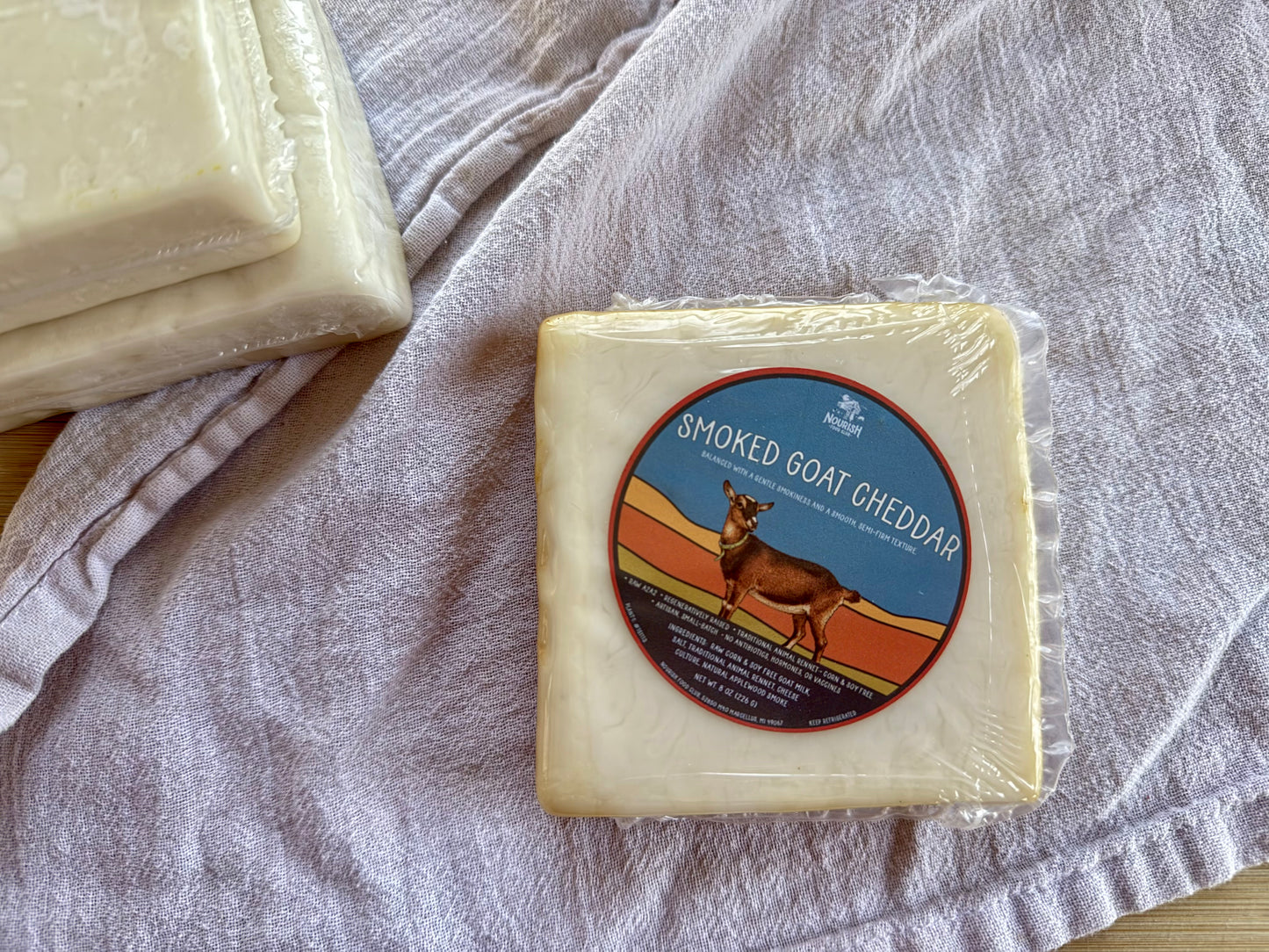
Smoked Raw Goat Cheddar
Smoked Raw Goat Cheddar
8 oz

Smoked Raw Goat Cheddar
Smoked Raw Goat Cheddar
8 oz
Raw
A2-A2
Corn & Soy Free
- Raw
- A2A2
- Regeneratively Raised
- Corn & Soy Free
- Traditional Animal Rennet
- Artisan, Small-Batch
- No Chemicals, No GMOS
- No Antibiotics, Hormones, or Vaccines
- Description
- Ingredients
- Standards
- Best Uses
This flavorful cheddar is crafted using traditional animal rennet, a method passed down through generations, rather than the genetically modified microbial enzymes used in most commercial cheeses. This dedication to tradition creates a cheese that’s deeper in flavor and easier on the digestive system.
What sets our Raw Goat Cheddar apart? It all starts with our goats, who graze freely on lush, nutrient-dense pastures. By regularly rotating them to fresh grass, they enjoy a varied, sun-soaked diet that results in the highest quality milk.
All dairy goats require supplemental feed to support their high metabolism and unique digestive system. Unlike most farms that rely on generic non-GMO feed containing PUFA-rich ingredients like soy, corn, canola, and sunflower seeds, we’ve developed a custom, low-PUFA, organic feed for our goats. This ensures that our milk, and, in turn, our cheese, is free from harmful pesticides and excess polyunsaturated fats (PUFAs), preserving both taste and nutrition.
Our goats’ milk is naturally A2/A2, making it easier to digest, with a sweet, smooth flavor. The result is a cheddar that’s bold and full of flavor, packed with nutrients like bioavailable calcium, vitamin K2, and probiotics that support gut health and overall wellness.
More than just delicious, our Raw Goat Cheddar is a testament to the care and dedication we put into every step of our farming and cheesemaking process. Enjoy this authentic, high-quality cheese that celebrates tradition, supports the health of our animals, and nourishes your body.
To get the full benefits of raw cheese, it’s best to enjoy it uncooked or add it to dishes at the end of cooking when the heat is lower. What makes raw cheese unique? It’s made from raw milk, which means it’s never heated above 110°F, the temperature the milk comes out of the cow’s teat, preserving its natural enzymes, probiotics, and beneficial bacteria.
Here are some of the best ways to enjoy raw cheese:
- Raw Enjoyment: Eat it straight as a snack, include raw slices in your meals, or pair it with fresh fruit on a charcuterie board for a delicious, easy snack.
- Toppings After Cooking: Add raw cheese to dishes after they’ve been cooked, such as thinly slicing, grating or shredding and placing it on top of a bowl of roasted potatoes, rice, eggs, hashes, sourdough bread slices, or a freshly cooked burger patty. For pasta, stir in chunks after cooking or freshly grate. For pizza, sprinkle it atop a freshly baked sourdough crust with tomato sauce and herbs for a delightful touch.
With this approach, you allow the cheese to gently melt a top your cooked meal without exposure to high heat.
While it’s best to avoid high heat, don’t be afraid to use raw cheese in dishes above 110°F! You don't ruin the cheese and it doesn't lose all of its value! While some of its probiotic and enzymatic benefits may be lost, key nutrients like CLA, Vitamin K2, and bioavailable minerals like calcium will still be present. The rich, complex flavors of the cheese will still enhance your recipes.
For maximal gut health benefits, consuming cheese in its raw form or using low-heat cooking methods is your best bet!
However, even when cooked, the high quality of our raw cheese, thanks to the care and pasture-raised diets of the goats, means that it still adds a ton of nutritional value and depth of flavor to your meals.
- BarbRated 5 out of 5 stars6/19/265 Stars
Nourish Food Club is the ONLY place I buy ALL my cheeses now. They are absolutely delicious!!
- Petronella B.Verified BuyerRated 5 out of 5 stars5/2/265 Stars
Love it all.
- Tom F.Verified BuyerRated 5 out of 5 stars3/11/265 Stars
Good tasting cheese
- CONNIE B.Verified BuyerRated 4 out of 5 stars3/5/264 Stars
Very strong flavor but great quality
- Nanette V.Verified BuyerRated 5 out of 5 stars3/3/265 Stars
Always fresh and excellent
Farming Practices

Raw & Nutrient-Dense
For thousands of years, raw cheese has been a dietary staple for good reason: it’s packed with natural enzymes, probiotics, and vital nutrients that support digestion and overall health. When milk is pasteurized, many of these beneficial components are lost, which is why raw cheese is often easier to digest and more nutrient-dense. The natural enzymes and probiotics in raw cheese integrate into the gut microbiome, supporting digestive health and helping maintain microbial balance. It truly is Mother Nature’s probiotic, delivering benefits that pasteurized cheese simply can’t match.
In addition to its probiotic power, raw cheese is rich in a number of heat-sensitive compounds such as lactoferrin, a powerful antimicrobial and anti-inflammatory protein that promotes gut health by encouraging the growth of good bacteria, protecting the gut lining, and preventing harmful toxins from entering the bloodstream. Lactoferrin also supports bone health, improves cognitive function, and enhances metabolic function. Since lactoferrin is a heat-sensitive protein, its concentration and bioactivity is reduced through pasteurization.
Our raw cheese is made from milk sourced from rotationally grazed livestock on diverse, nutrient-rich pastures. This results in cheese with higher concentrations of vitamins, minerals, and phytonutrients, bioactive compounds that have anti-inflammatory, gut-supporting and anti-carcinogenic properties.
With its superior nutrient profile, it’s no wonder that so many of our customers can finally enjoy cheese again!

Traditional Animal Rennet, No GMOs
If you’ve ever struggled to digest cheese, it might not be the dairy itself, but instead, how its made. At Nourish, we honor traditional cheesemaking methods, using only natural animal rennet to curdle our milk.
Unfortunately, over 90% of cheese in the U.S. is made with fermentation-produced chymosin (FPC), a genetically modified enzyme that has only been minimally tested for long term safety. Many who find conventional cheese hard to digest may actually be reacting to FPC, not the dairy itself. In contrast, our cheese is made the old-fashioned way, with just four simple ingredients: milk, salt, starter culture, and traditional animal rennet.
Animal rennet, derived from the stomach lining of ruminant animals like cows, has been used for thousands of years and is naturally easy to digest. It is a far cry from the synthetic, lab-made alternatives used in most mass-produced cheese. By using animal rennet, we ensure that our cheese is pure, nutrient-dense, and free from genetically modified ingredients. No synthetic enzymes, no shortcuts, just real, traditional cheese that’s as nature intended, making it easier for your body to enjoy and benefit from.

The A2A2 Difference
Many of our customers have found they can finally enjoy dairy again, and the key is that all of our cheese is made from milk from A2A2 cows, goats, and sheep, which means the dairy contains only the A2 casein protein variant, which is easier to digest for many relative to A1 casein. Historically, humans only consumed A2 dairy from traditional breeds of cows, goats, and sheep, which naturally produce the A2 form of beta-casein. The shift to A1 dairy has occurred relatively recently with the rise of modern commercial breeds like the Holstein. Unlike typical cheese on the market, which contains a mix of A1 and A2 casein, our cheese is carefully crafted from A2A2 milk, making it gentler on the digestive system.
This difference is especially relevant when it comes to cheese, as it’s almost pure casein, since most of the whey is drained out during the cheese-making process. The casein proteins in cheese are concentrated, and with our A2A2 dairy, you’re getting a smoother, easier-to-digest option. A2A2 dairy has been shown to improve gut health, lactose tolerance, and overall digestive comfort. For those sensitive to traditional dairy, switching to our A2A2 cheese can offer a more enjoyable experience without the discomfort.