- Reviving Tradition
- All-In-One Kits
- Seed-to-Fork
- Heritage Grains
- Stone-Milled


- Reviving Tradition
- All-In-One Kits
- Seed-to-Fork
- Heritage Grains
- Stone-Milled
-
Heritage Wheat & Ancient Grains
Chemical Free
GMO Free
Build Your Own Flour Box Build Your Own Flour Box
$65 - $90 -
Heritage Wheat
Chemical Free
GMO Free
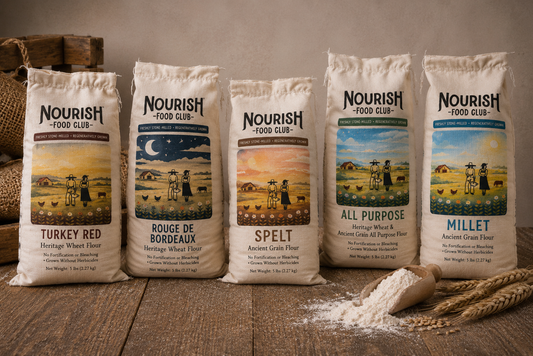
Rouge de Bordeaux Wheat Flour Rouge de Bordeaux Wheat Flour
5 lb
Regular price $32.25$32.25 Regular priceUnit price per -
Heritage Wheat
Chemical Free
GMO Free
Turkey Red Wheat Flour Turkey Red Wheat Flour
5 lb
Regular price $29.95$29.95 Regular priceUnit price per -
Heritage Wheat
Chemical Free
GMO Free
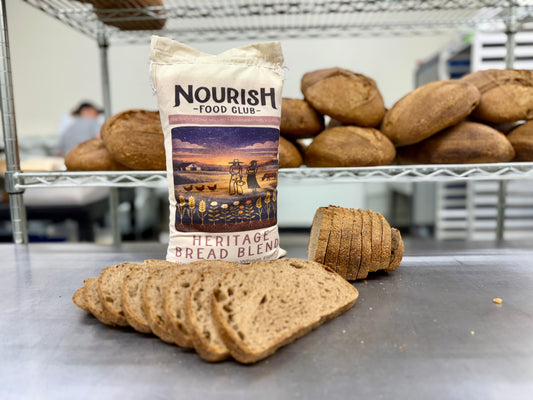
Heritage Wheat Bread Flour Heritage Wheat Bread Flour
5 lb
Regular price $33.25$33.25 Regular priceUnit price per -
Sourdough
Heritage Wheat
Chemical Free
Sourdough Starter Kit Sourdough Starter Kit
Regular price $70.71$70.71 Regular priceUnit price per -
Sourdough
Heritage Wheat
Chemical Free
Doughlores Sourdough Starter Doughlores Sourdough Starter
Regular price $23.56$23.56 Regular priceUnit price per -
Heritage Wheat
Ancient Grain
Chemical Free
Heritage Wheat All Purpose Flour Heritage Wheat All Purpose Flour
5 lb
Regular price $33.25$33.25 Regular priceUnit price per





Frequently Asked Questions
What are the health benefits of sourdough bread?
But first, what actually is sourdough bread?
Sourdough is the oldest form of leavened bread, dating back over 5,000 years. (Leavened simply means the bread rises because a leavening agent produces gas, creating air pockets that make it light and airy instead of dense.)
Long before commercial yeast packets existed, dough was left out and naturally fermented by wild yeast and beneficial bacteria in the environment. That slow, natural fermentation is what made the bread rise.
Unlike modern bread-making, which often prioritizes speed and shelf life, traditional sourdough relies on time. With just flour, water, and salt, the fermentation process transforms the dough before it’s ever baked. During this slower rise, naturally occurring microbes begin breaking down some of the starches and proteins in the flour. This not only develops deeper flavor and better texture, but can also increase nutrient bioavailability and make the bread easier for many people to digest.
In simple terms, sourdough changes how the flour is processed before you eat it. It alters the structure, the flavor, and how your body handles the bread.
⦁ Easier Protein Digestion: Long fermentation partially breaks down gluten proteins, improving digestibility for many individuals.
⦁ Supports Gut Health: Fermentation modifies fiber structure and generates fermentable compounds that nourish beneficial gut bacteria and support SCFA production.
⦁ Improved Mineral Bioavailability: Activation of phytase reduces phytic acid, increasing absorption of minerals like zinc, magnesium, calcium, and iron.
⦁ Increased Polyphenol Bioaccessibility: Fermentation releases bound antioxidant compounds in whole grains, enhancing their availability.
⦁ Reduced Mycotoxin Levels: Certain sourdough microbes can bind or degrade specific mycotoxins, adding an extra layer of protection.
⦁ Better Blood Sugar Response: Organic acids and structural changes to starch may promote steadier glucose release and fewer dramatic post-meal spikes.
⦁ Structural Modification of Starch: Enzymatic pre-digestion and acidification alter starch behavior, supporting improved tolerance and slower digestion.
⦁ Lower Acrylamide Formation: The acidic fermentation environment can reduce acrylamide formation during baking compared to conventional yeast bread.
You can learn more about the difference between sourdough and modern yeast bread, and the science behind the health benefits in my blog post here.
Is pasture raised beef the same as grass fed and finished beef?
No. Pasture raised beef and 100% grass fed and finished beef are not necessarily the same thing.
Pasture raised describes where cattle live. Grass fed and finished describes what they eat.
Cattle can be raised on pasture for much of their lives and still receive supplemental grain or be moved to a feedlot and grain finished before harvest. So seeing “pasture raised beef” doesn't necessarily mean the cattle ate grass their entire lives.
At Nourish Food Club, we require both. Our cattle are pasture raised AND 100% grass fed and grass finished, grazing grasses and other pasture plants from beginning to end.
And we take it one step further. Our cattle are rotationally grazed using regenerative farming practices, so we're intentionally managing how they move across the pasture, too.
Where they live matters. What they eat matters. And how they're managed on the land matters.