Glyphosate Resistance Is Growing, and Here Comes Glufosinate
Glyphosate now has a backup partner in crime.
Meet glufosinate.
Both glyphosate and glufosinate are broad-spectrum herbicides, meaning they’re designed to kill almost any plant they touch. They’re not selective, which can make them incredibly effective to decimate weeds. If it’s green, it’s a target! Weeds, grasses, broadleaf plants, etc.
But while they share that ‘goal’, they work through different chemical pathways, which is why glufosinate is becoming increasingly popular.
Not because it’s safer.
But because glyphosate is starting to fail.
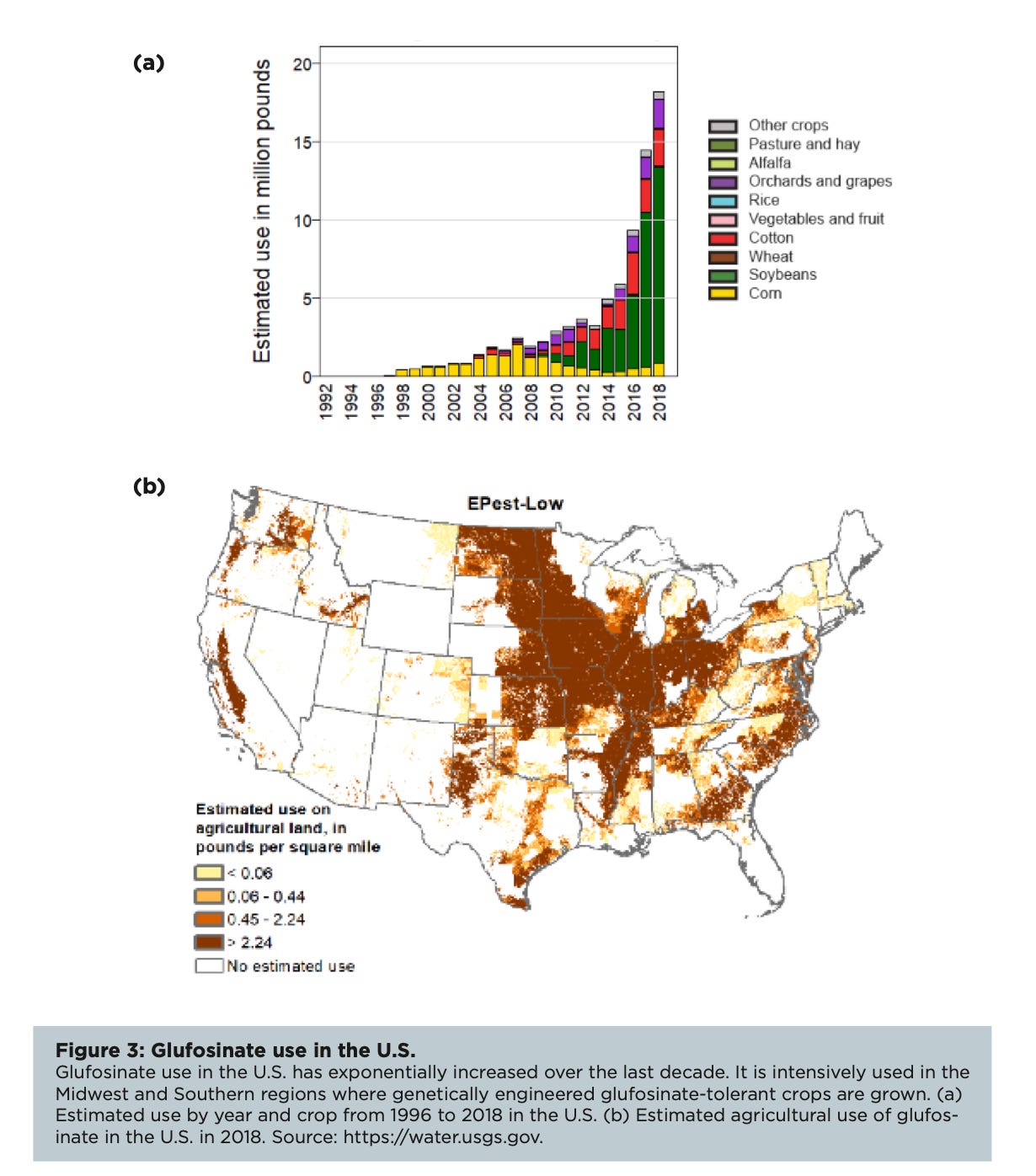
Figure from Friends of Earth illustrating the recent rise in Glufosinate use.
The Rise of Glyphosate
Glyphosate was first synthesized in 1950 by a Swiss chemist working for a pharmaceutical company. At the time, it was investigated as a metal chelating agent (a compound that binds minerals such as calcium, magnesium, and iron) making it potentially useful for cleaning pipes, descaling industrial equipment, or softening water. Then in 1970, a Monsanto chemist discovered that glyphosate had powerful herbicidal properties, leading the company to commercialize it in 1974 as the herbicide Roundup.
Glyphosate works by inhibiting an enzyme called EPSP synthase, which is part of the shikimate pathway, a metabolic pathway plants use to produce certain aromatic amino acids. Without these amino acids, the plant can’t synthesize proteins necessary for growth, and it eventually dies over several days to weeks as it essentially starves.
A common argument made by ‘pro-glyphosate’ people is that glyphosate shouldn’t affect humans because we don’t have the shikimate pathway. While that’s technically true for human cells, it leaves out an important piece of the picture: our gut microbes do have this pathway. And the total number of microbial cells living in and on our bodies is roughly equal to the number of human cells inside of us.
Because glyphosate targets this pathway, researchers have raised questions about how repeated exposure could affect the gut microbiome, which plays a key role in digestion, immunity, and overall health. Glyphosate has been classified by the International Agency for Research on Cancer as a “probable human carcinogen”, (ref) and more and more research is demonstrating how cumulative exposure negatively affects our microbe rich guts (ref, ref), disrupting gut microbiome balance, impacting digestion and food tolerance.
But when first put on the market, it was revolutionary. It transformed weed control in agriculture.
Then in 1996, glyphosate use exploded when genetically modified crops (Roundup Ready soybeans, corn, and cotton) were introduced. These crops were engineered to be glyphosate-resistant. Farmers could plant seeds, spray glyphosate, and nearly every competing weed would die.
Agriculture began to resemble something closer to a chemical lab protocol instead of working with a living ecosystem.
But Mother Nature will always win when we try to fight it with chemicals.
Heavy reliance on a single herbicide creates massive selection pressure on weeds. And over time, weeds adapted.
Today, more than 50 weed species worldwide are resistant to glyphosate, including palmer amaranth, marestail, and ragweed.
For many farmers, spraying glyphosate alone simply doesn’t work anymore.
So what happens next?
You introduce the next toxic chemical of course!
Enter Glufosinate
Glufosinate was first introduced in the 1980s and registered for agricultural use in the early 1990s.
Its use expanded in the late 1990s with the launch of LibertyLink crops (ref), varieties of corn, soybeans, cotton, and canola genetically engineered to tolerate glufosinate. (Again meaning you could spray the entire field, kill anything green that would compete for crop growth, yet the GMO crop lives on).
Instead of replacing glyphosate, glufosinate is often currently used alongside it kind of like a backup weapon when weeds stop responding to the first one.
While total glufosinate use is still smaller than glyphosate, it has increased significantly since around 2010, as glyphosate-resistant weeds have spread across the US.
And if history tells us anything, this pattern will likely repeat.
Until weeds evolve resistance again… and the next toxic (yet profitable) chemical enters the stage.
How Glufosinate Works
Glufosinate kills plants through a different biochemical pathway relative to glyphosate.
It inhibits an enzyme called glutamine synthetase, which plays a critical role in nitrogen metabolism.
Normally, this enzyme converts glutamate + ammonia into glutamine.
This process essentially detoxifies ammonia in plant cells that becomes toxic at a specific level.
So when glufosinate blocks that enzyme, ammonia rapidly accumulates to toxic levels, nitrogen metabolism collapses, cell membranes are damaged, photosynthesis shuts down, and plants die within 24-72 hours.
Unlike glyphosate, which moves throughout the entire plant, glufosinate mostly acts as a contact herbicide, killing the plant tissue it directly touches.
Glufosinate GMO Wheat, Coming Soon?
While not yet used on the market, genetically engineered wheat (a new variety called HB4 wheat developed by Bioceres Crop Solutions) was approved for use in the US in 2025 by regulators. (So now it’s just a matter of time before its planted on US crop ground and part of our bread supply).
It’s marketed as “drought tolerant,” but the more important trait is that it is engineered to tolerate glufosinate…
Similar to the ‘RoundUp Ready’ corn/soy model, farmers can spray glufosinate directly onto wheat fields. The weeds die. The wheat survives.
Great, our flour will now have another pesticide residue! Have regulators studied cumulative exposure to multiple pesticide forms over a long period of time? Nope!
The Human and Environmental Health Questions
The enzyme glufosinate blocks (glutamine synthetase) is not unique to plants.
Humans and animals also rely on this enzyme, particularly in the brain, liver and kidneys. In the brain, glutamine synthetase plays an important role in regulating glutamate and ammonia, which are critical for normal neural function.
Because of this, the toxicology literature has raised several concerns related to glufosinate exposure including neurotoxicity, developmental and reproductive toxicity, birth defects, miscarriages, low birth weight, disruption of the gut microbiome, kidney and respiratory toxicity, and potential DNA damage. (ref, ref)
Some animal studies have reported developmental effects such as reduced birth weight, premature birth, and neurological changes in offspring following prenatal exposure.
Other studies have observed anxiety-like behavior, memory impairment, and altered locomotor activity in animal models. (ref)
Glufosinate has also been associated with acute neurological poisoning cases in humans at higher exposure levels. (ref)
For these reasons, some regulators have raised concerns about its toxicity profile, and some even believe it is more toxic than glyphosate.
While it remains approved and widely used in the United States, glufosinate is banned for agricultural use in the European Union, the United Kingdom, and France. The EU and France have also restricted imports of foods containing residues of glufosinate.
A Growing Chemical Market
Now glyphosate is still by far the dominant herbicide.
Roughly 275–300 million pounds are applied annually in U.S. agriculture (ref), and it’s used on close to 300 million acres of cropland (ref). It’s sprayed on crops like soybeans, corn, and cotton, and even used as a desiccant to dry crops like oats, wheat, and legumes to speed up harvest (giving some crops a nice glyphosate bath right before it’s turned into food).
Glufosinate current use is smaller, estimated around 5–20 million pounds annually, but it is growing as glyphosate-resistance develops.
Major manufacturers of glufosinate include Bayer, BASF, Syngenta, Corteva (big players in Big Ag).
Along with a number of Chinese chemical producers rapidly expanding production.
And the global glufosinate market is projected to grow from $2.85 billion in 2025 to roughly $4.4 billion by 2030.
So in other words, this is becoming very big biz-ness!
The Rise of Herbicide “Stacks”
A newer trend in agriculture as a result of weed resistance is something called herbicide stacking where crops are now engineered to tolerate multiple herbicides at once (ref).
Some varieties are designed to tolerate three or even four herbicides simultaneously, including glyphosate, glufosinate, dicamba, and 2,4-D.
Farmers can now spray several of these chemicals during the same growing season, for a multi-chemical bath.
So when some people say “glyphosate use has plateaued,” that may technically be true… But total herbicide use hasn’t declined. It’s simply being stacked with other chemicals.
The Chemical Treadmill
We’ve seen this story time and time again.
When Roundup Ready crops were introduced in the 1990s, farmers were told they would reduce pesticide use.
Instead, herbicide use increased dramatically as weeds developed resistance.
When fighting Mother Nature with chemistry, farmers became trapped in what many call a chemical treadmill: needing stronger chemicals or larger quantities to control weeds that keep adapting.
Glyphosate weed-resistance is increasing, and glufosinate resistance appears to be following a similar trajectory.
Which raises a simple question…
If weeds eventually evolve resistance to glufosinate too, what’s the next chemical lined up?
Big Ag chemical companies truly have a remarkable business model: trap farmers and the food system in a chemical-dependent cycle, then continue selling the next generation of profitable chemicals as resistance develops, often while being shielded from much of the liability tied to the health consequences.
A Different Path
There is another approach.
Regenerative farming systems focus on soil health, crop diversity, and ecological resilience, rather than chemical control. (And yes this is being done on livestock farms and on row crop farms!)
These systems can improve soil microbiome diversity, soil structure, water retention, nutrient retention, mineral accessibility, natural pest resistance, and drought resilience.
But unlike patented herbicides and genetically engineered seeds, healthy soil isn’t a product you can sell.
Which may be why it receives far less attention.
Support a regenerative farmer this weekend, whether they raise livestock or grow crops like wheat.
Truthfully, a large portion of the crops sprayed with glyphosate and glufosinate end up as livestock feed. That’s why it’s important to ask your farmers where their feed is sourced and how it's grown.
The more we choose to support farmers working with nature instead of relying on chemical-intensive systems, the more we can collectively shift market demand and standards over time.
At Nourish Food Club, we’re working to build an alternative food system centered around small regenerative farmers, both livestock producers and crop farmers growing grains and row crops for our custom corn- and soy-free feed, as well as heritage wheat for our flour and sourdough products. The goal is simple: produce cleaner food while restoring soil health.