Do Drug Residues End Up in Meat, Milk, and Eggs? Understanding MRLs and Food Testing Gaps

Do Drug Residues End Up in Meat, Milk, and Eggs? Understanding MRLs and Food Testing Gaps

In Part 1, we broke down how drug use has become a routine part of conventional meat production, and why the system depends on it.

But that understanding naturally leads to an important question:

What happens after those drugs are used?

Do they stay within the animal… or do they carry through as drug residues in the meat, milk, and eggs we eat?

Do drugs end up in our food?

Yes, drug residues can and do make their way into the food we eat. (ref, ref)

This isn’t just theoretical. It’s a biological reality.

When animals are given drugs, those compounds don’t simply disappear. They are absorbed, metabolized, and distributed throughout the body. And in some cases, residues (or their metabolites) can remain in tissues that ultimately become part of the food supply.

What animals are exposed to doesn’t stay isolated. It can carry through to meat, milk, eggs, and other animal products.

While violations do occur each year, modern regulatory programs show that the majority of products test below what regulators consider acceptable thresholds.

But that doesn’t mean residue-free.

“Compliant” does not mean residue-free.

It means levels are below the Maximum Residue Limit (MRL), more on that below.

In fact, ongoing testing continues to detect trace levels of antibiotics, antiparasitics, and other veterinary drugs in meat, milk, and eggs. And studies are finding multiple drug residues within a single sample, highlighting how complex real-world exposure can be.

Drug residues have been documented across a wide range of animal foods (ref), including:

> Meat (beef, pork, poultry)

> Milk and dairy

> Eggs

> Honey and

> Seafood

As one review summarizes (ref):

“Veterinary medications used for disease treatment and prevention may remain in animal-derived foods such as milk, eggs, honey, meat or organs… which could pose a risk to public health.”

Today, more than 200 veterinary drug residues from various classes (antibiotics, antiparasitics, and anti-inflammatories) have been identified across different food products. (ref)
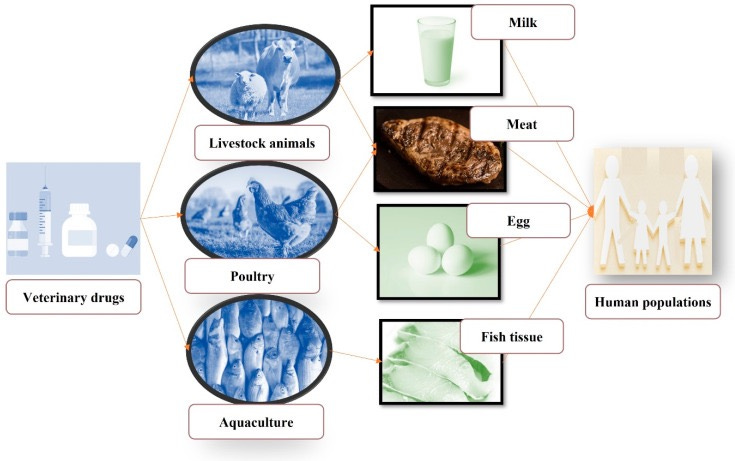
Image from ref.


The presence of residues isn’t surprising, it’s supported by well-understood biological mechanisms.

  • > Some drugs, like tetracyclines, can circulate widely in the body and persist in tissues and fluids (ref).

  • > Others are excreted into bile and then reabsorbed, allowing them to remain in the body longer than expected (ref).

  • > Certain compounds, like tylosin, are poorly biodegradable and can persist in food products such as milk, meat, eggs, and honey. (ref)

  • > And some residues, like sulfonamides, remain stable even during freezing or storage, meaning they don’t easily break down once present (ref).

Even after treatment ends, residues don’t always disappear immediately. Antibiotics can still be detected in milk after official withdrawal periods (ref), and drug residues can transfer into eggs and persist long after use (ref, ref, ref, ref).

If regulations exist, why do residues still show up?

In practice, there are several well-documented reasons:

  • - failure to follow withdrawal periods (ref)

  • - improper or extra-label drug use (ref)

  • - lack of awareness about what qualifies as a drug (ref)

  • - environmental contamination (feed, equipment, housing surfaces)

  • - incomplete cleaning of medicated equipment (ref)

There’s also a knowledge gap within the system itself. As one farmer put it:

“There’s a lack of understanding around antibiotics… I have a friend selling calves as ‘all natural’ who didn’t realize certain drugs were antibiotics.”

Even with regulations in place, the system relies heavily on precise compliance and human execution. And that’s where gaps can occur.

But beyond individual errors, there’s another layer to consider: the limitations of how drug residues are regulated and tested in the first place.


How is food regulated for drug residues?

In the United States, drug residues in food are regulated through a combination of FDA and USDA oversight programs.

But it’s important to understand something upfront: the regulatory standard isn’t zero. It’s what’s legally “allowed.”

These limits are known as Maximum Residue Limits (MRLs): the highest level of a drug or chemical legally permitted to remain in food products like meat, milk, and eggs. MRLs are designed to keep residue levels below thresholds considered safe for human consumption.

They are based on something called an Acceptable Daily Intake (ADI), an estimate of how much of a substance a person can consume daily over a lifetime without significant risk. From there, regulators determine how much of that compound is allowed to remain in specific foods.

For many animal products, there is no continuous on-farm testing. Instead, oversight relies on targeted residue testing programs, random sampling, and inspection at slaughter or processing. Meaning, not every batch of meat is tested. Only a fraction of the products are actually sampled. But if the residues are found to be above legal limits, products can be condemned and then traced back to the source.


Conventional milk is the most tightly monitored food in this drug regulatory system. Every bulk milk tanker is screened before it can be processed, making it one of the most consistently tested foods. Any tanker that tests positive is immediately rejected and discarded. According to the FDA’s 2024 National Milk Drug Residue Database report (ref), over 3.6 million milk samples were tested in a single year, with just 301 testing above the MRL, about 0.008% of samples. In 2024 alone, nearly 10 million pounds of milk were dumped after triggering positive residue tests.

At first glance, this suggests a highly effective system, and in many ways, it is.

But it’s important to understand what this testing is actually designed to detect.

Routine milk screening focuses primarily on common antibiotics, especially beta-lactams, and a limited number of required drug classes. It is not a comprehensive screen for all possible compounds.

In fact, FDA surveys have identified additional drugs in milk that are not routinely tested for (ref), including fluoroquinolones, gentamicin, sulfamethazine, and macrolides. So while every load is screened for certain compounds, not every load is fully analyzed.

Plus, a “negative” test result does not mean a product is completely free of drug residues. It means none were detected above the threshold for the specific compounds being tested. Substances outside the testing scope, or residues present below detection limits, may not be captured.


Eggs are monitored differently, and often less intensively.

In the U.S., egg testing is conducted through programs like the USDA’s National Residue Program and FDA targeted sampling efforts. These programs focus on certain antibiotics, some banned drugs, and a limited set of anticoccidials.

But unlike milk, eggs are not tested batch-by-batch. Instead, testing is based on surveillance sampling, meaning only a portion of the total egg supply is ever directly analyzed. (Similar to meat)

Like most foods in the system, egg testing is targeted rather than comprehensive. It is designed to detect known high-risk compounds and potential violations of regulatory limits, not to measure the full range of residues that may be present.

When researchers go beyond these standard testing methods and use broader, more sensitive analytical techniques, they often detect a wider range of compounds.

Studies have identified residues from multiple drug classes in eggs, including coccidiostats, sulfonamides, macrolides, and even banned substances like nitrofurans.

This doesn’t necessarily mean regulatory MRLs are always being exceeded, but it does show that low-level, multi-compound residues can and do exist.


One of the main limitations of this regulatory system is how these limits are set.

They are established one compound at a time, for one food at a time.

But that’s not how real-world exposure works.

People consume multiple foods, each potentially containing residues from different compounds. So in reality, exposure is cumulative, not isolated.

There is currently no routine system in the U.S. that measures total drug burden across the diet. And there is no standardized way to assess combined exposure to multiple residues at low levels.

Most monitoring programs are designed to detect violations, not to fully characterize what consumers are exposed to over time.


Honey offers an interesting extension of this idea. It is another animal-derived food, yet it is often perceived as pure, natural, and minimally processed. However, drugs are also used in beekeeping to manage disease, and residues have been detected in honey.

Like other animal products, honey is subject to regulation for drug residues, and certain antibiotics used in beekeeping have established limits in some countries. But in the United States, the regulatory framework is less clearly defined. There are no established maximum residue limits for honey, and large-scale, routine surveillance data on finished retail honey products is limited. Most testing tends to be targeted, often focusing on imports or specific violations rather than broad monitoring of the overall supply.

This makes honey a useful example of a broader pattern: drugs can be used, residues can be present, and regulations can exist, yet real-world exposure data remains limited. And in a food that many people assume is untouched, it highlights how these questions extend beyond just meat, milk, and eggs.

Image from ref.

MRLs are also not universal. Different countries set different standards and limits for the same compounds.

A 2025 analysis from the University of Nebraska (ref), comparing U.S. standards to Codex Alimentarius (the international benchmark for food safety), found that U.S. limits for veterinary drug residues are often more lenient than those used by many major trading partners.

The study uses a “stringency score,” where a negative score indicates the U.S. allows higher levels of residues compared to global standards.

Across multiple categories, U.S. standards were found to be less stringent:

  • > Beef (−3.00): less strict than 9 of its top 10 export markets, including the European Union, Hong Kong, and Mexico

  • > Poultry (−9.07): more lenient than all major trading partners, with large gaps compared to China, Mexico, and Taiwan

  • > Pork (−3.05): less strict than countries like China, Japan, and Canada

  • > Dairy (−3.87): more lenient across all major export destinations

Meaning, food produced under U.S. standards can legally contain higher levels of certain drug residues than would be permitted in other parts of the world.

(This pattern is also seen in pesticide regulations!)

For some antibiotics, the difference is substantial.

For example, the U.S. allows up to 0.5 ppm of certain tetracyclines in muscle meat, while the European Union sets a much lower limit of 0.1 ppm, a five-fold difference. For other tissues, like liver and kidney, the gap can be even larger.

Not every compound follows this exact pattern, but the broader point remains: different countries draw the line for what is considered “safe” in very different places.

And in some cases, the difference goes even further.

And as discussed previously, some drugs like beta-agonists and growth-promoting hormones used in U.S. beef production are permitted with regulated residue limits, while being completely banned in other countries.

Take ractopamine, a beta-agonist used in pork and beef production. It is approved in the United States, with established residue limits in meat. But it is banned in over 150 countries, including the European Union and China, due to concerns about human health effects and differences in how safety is evaluated.

These differences reflect fundamentally different regulatory philosophies. The U.S. system is largely built around determining what level of exposure is considered acceptable, allowing residues as long as they fall below modeled safety thresholds. The European approach is often more precautionary, placing greater emphasis on limiting or eliminating exposure when uncertainty exists.

So when one country allows a compound at a certain level, and another bans it entirely, it raises an important question…

If the science were truly settled, wouldn’t the standards be the same?

At that point, the conversation shifts. It’s no longer just about whether residues are present. It becomes about how much exposure is considered acceptable, and who gets to decide.

Those decisions don’t just shape regulatory limits.

They shape the structure of the food system itself.


What does independent testing show?

Beyond regulatory monitoring programs, independent studies and targeted testing efforts offer a different lens into the food supply.

Instead of asking whether specific drugs exceed legal limits, these analyses often look more broadly at what is actually present.

And the results can be surprising!

  • > A recent analysis of ready-to-eat ham detected 14 different veterinary drug residues across samples. (ref)

  • > Antibiotic residues have also been detected in beef labeled “raised without antibiotics.” (ref) What’s notable is that while the USDA approves this label, it does not require routine residue testing to verify it. Instead, the claim is based on production practices and documentation, not consistent end-product testing.


Similar findings have been observed in smaller-scale and local systems.

In one U.S.-based study, researchers purchased beef, eggs, and honey labeled “antibiotic-free” from farmers’ markets in East Tennessee and tested them for common antibiotic residues (ref).

They found:

  • - Tetracycline residues in all samples

  • - Sulfonamides in every beef sample and many egg samples

  • - Erythromycin in all beef and honey samples

Even though concentrations were low, this study shows that residues can still be detected, even in products marketed at farmers markets marketed as ‘antibiotic-free’.


Multiple international studies (ref) have also documented antibiotic residues in eggs:

  • - One study found 8.6% of eggs contained residues from 12 different antibiotics

  • - Another detected 16 antibiotics in over 30% of samples, with some compounds appearing in up to 84% of eggs tested

  • - A third study found 30% of eggs contained antibiotic residues, with some exceeding regulatory limits in that country

  • - In backyard systems, detection rates were even higher, with one study finding 73% of eggs contained at least one drug residue

While this reference includes some studies from outside the U.S., they demonstrate a consistent biological reality: when hens are exposed to drugs, residues can transfer into eggs.

It’s also worth noting that the U.S. imports eggs and egg products, though in relatively small amounts.

In 2024, the United States imported $90.3 million in eggs, primarily from Canada ($42.3M), the United Kingdom ($15.6M), and China ($7.49M) (ref). These imports are required to meet U.S. standards, but like domestic products, they are evaluated using targeted, risk-based testing,not comprehensive screening.


Other analyses have looked at finished food products.

A 2023 analysis of fast food items (ref) detected multiple veterinary drugs:

  • > 60% of samples contained monensin, an ionophore antibiotic not approved for human use

  • > 40% contained narasin, another ionophore used in animal feed

  • > One Chick-fil-a sample contained nicarbazin, an antiparasitic and avian contraceptive


In a separate 2026 analysis of military food products (ref), researchers screened for over 130 compounds and detected five veterinary drugs across the ten food samples:

  • > Monensin was found in 50% of samples. While approved for limited veterinary use, it is banned for human use as monensin is known to cause cardiac toxicity, weakness, gastrointestinal distress, and sudden death (ref)

  • > Trenbolone acetate (a growth-promoting hormone widely used in US beef production) was detected at measurable levels

  • > Ractopamine, a growth promoter banned in many countries (ref), was also identified

  • > Hydroxy-dimetridazole, a banned antimicrobial, was detected at over 160 ppb in a teriyaki beef stick. Regulatory agencies say these are mutagenic and genotoxic, with studies demonstrating DNA damage, cancer risk and reproductive harm (ref)

  • > Nicarbazin was found at trace levels, an antiparasitic drug and avian contraceptive. This has been found in school lunch and fast food testing, suggesting widespread contamination of the food supply

Several of these compounds are not approved for human use and associated with toxicity or regulatory concern. And 4 of the 5 veterinary drugs found are manufactured in China and banned in 160 countries.
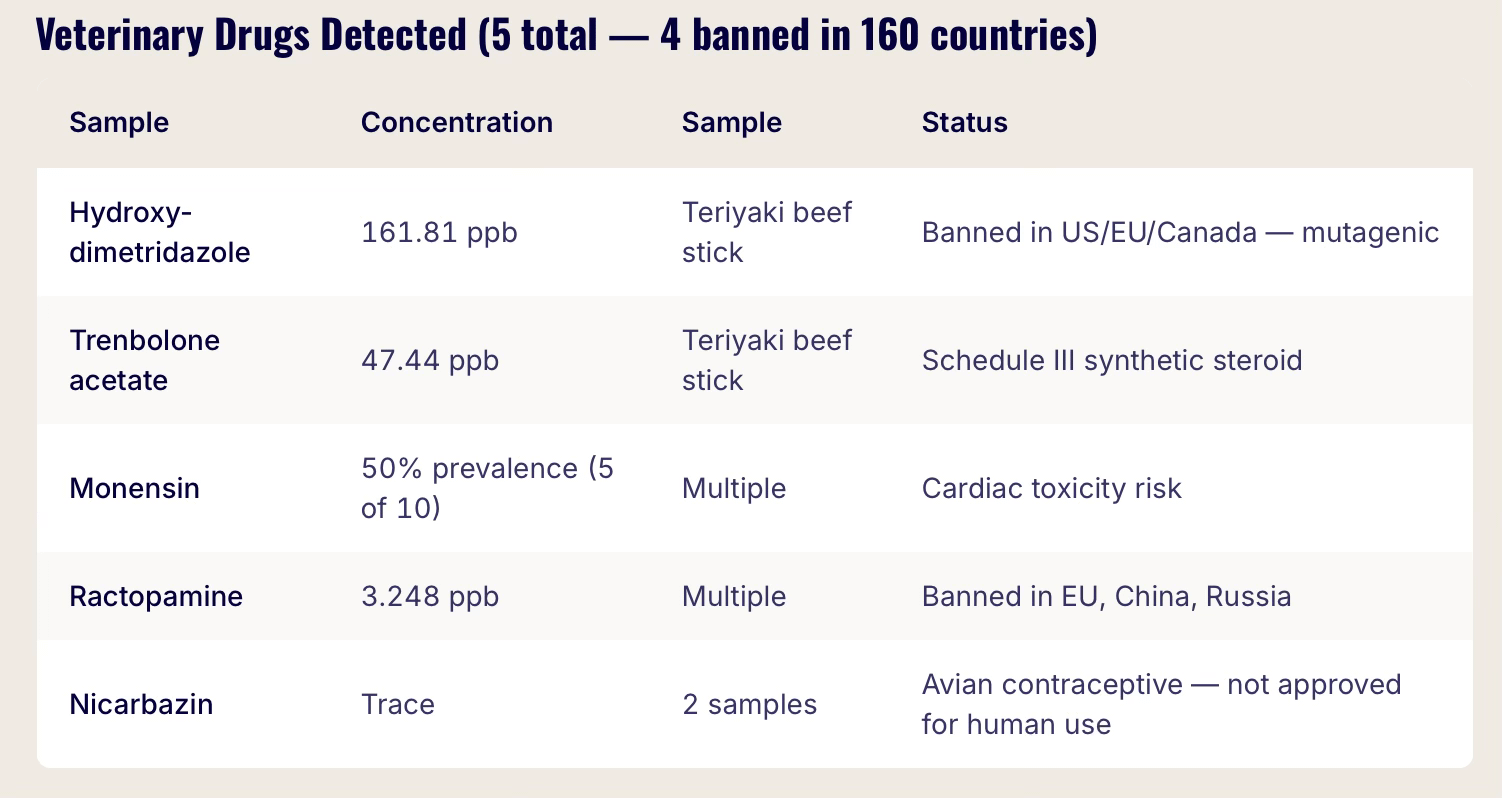

Taken together, the above findings don’t necessarily mean that regulatory limits are routinely exceeded.

But they do highlight something important:

When testing expands beyond standard regulatory screens, a wider range of residues is often detected.

This underscores a key distinction: regulatory systems are designed to identify violations, while independent studies often reveal what is simply present.

And those are not always the same thing!


Why this is still an active area of research

Detecting veterinary drug residues in food is still an active and evolving area of research.

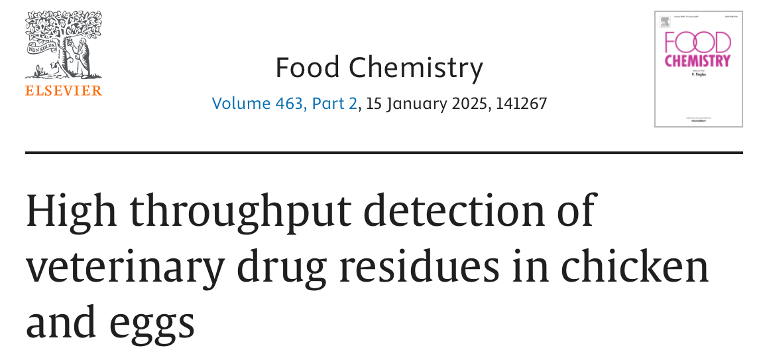
While modern testing tools can identify trace levels of antibiotics, beta-agonists, and other compounds, scientists are continuously working to develop more sensitive, accurate, and efficient methods. (ref, ref, ref)

As many research papers note (ref), veterinary drug residues in livestock products remain a persistent food safety challenge, and the rapid expansion of detection technologies shows that this field is still evolving.

Meaning, we are still improving our ability to detect what’s actually present in food, and that means we likely don’t yet have a complete picture of all drug residues that may be present.
Part of the challenge lies in the food itself.

Animal-derived foods are complex biological matrices, meaning they contain fats, proteins, and other compounds that can interfere with detection.

As one paper explains:

“The complexity of animal-derived food matrices… necessitates the development of both efficient pretreatment methodologies and highly sensitive and specific detection technologies.” (ref)

Another notes:

“The egg is a complex matrix and the antibiotic extraction from this matrix is a challenging step in the detection and quantification process.” (ref)

This makes testing more difficult than it might seem. Extracting and accurately measuring residues requires multiple steps, each with potential limitations. (ref)

Even after extraction, analyzing the data presents another layer of complexity.

To address this, new detection strategies are actively being developed (ref, ref, ref), including:

  • > Multi-residue screening methods that can detect many compounds at once

  • > Biosensors for faster, real-time detection

  • > AI-assisted analysis to improve sensitivity and reduce error

  • > Detection sensitivity to be able to detect lower concentrations more accurately

All of this points to an important reality: we often think of food testing as definitive, but the science behind detecting drug residues is still evolving.

That doesn’t mean current methods are ineffective.

But it does mean they are not perfect, especially when it comes to identifying multiple compounds at very low levels in complex food systems. Because at the end of the day, widespread drug use is a relatively recent addition to the food system!


Even with regulations in place, there are still meaningful gaps in how these compounds are monitored, measured, and understood.

What does this level of ongoing, low-level exposure mean for human health and for the environment?

In Part 3, we’ll take a closer look.

Ashley Armstrong

Latest Articles

Seasonal Eating Benefits: Why Eating In-Season Produce May Improve Health

Seasonal Eating Benefits: Why Eating In-Season Produce May Improve Health

Have you ever noticed how a perfectly ripe summer peach tastes completely different than one bought in the middle of winter? Or how the first strawberries of the season seem...

Seasonal Eating Benefits: Why Eating In-Season Produce May Improve Health

Have you ever noticed how a perfectly ripe summer peach tastes completely different than one bought in the middle of winter? Or how the first strawberries of the season seem...

Can Seed Oils Increase Sunburn Risk? How Dietary Fats Affect Skin Health and Sun Exposure

Can Seed Oils Increase Sunburn Risk? How Dietary Fats Affect Skin Health and Sun Exposure

For decades, we’ve been taught to fear the sun: cover up, avoid midday light, and rely heavily on sunscreen for protection. But the sun itself is not the enemy. Sun...

Can Seed Oils Increase Sunburn Risk? How Dietary Fats Affect Skin Health and Sun Exposure

For decades, we’ve been taught to fear the sun: cover up, avoid midday light, and rely heavily on sunscreen for protection. But the sun itself is not the enemy. Sun...

Eggshell toothpaste

Homemade Eggshell Toothpaste: A Simple Way to Reuse Your Eggshells

Learn how to make homemade eggshell toothpaste using finely ground eggshell powder, coconut oil, and a few simple ingredients. A practical, low-waste way to reuse leftover eggshells instead of throwing...

Homemade Eggshell Toothpaste: A Simple Way to Reuse Your Eggshells

Learn how to make homemade eggshell toothpaste using finely ground eggshell powder, coconut oil, and a few simple ingredients. A practical, low-waste way to reuse leftover eggshells instead of throwing...

Symptoms Are Not the Enemy

Symptoms Are Not the Enemy

Guest Contributor: Dr. Alex Orton, ND at havenholistichealth.com ------------------------------------------------------------------------------------ There's only one disease. This is the cure. You have been at war with your body for your whole life. Well,...

Symptoms Are Not the Enemy

Guest Contributor: Dr. Alex Orton, ND at havenholistichealth.com ------------------------------------------------------------------------------------ There's only one disease. This is the cure. You have been at war with your body for your whole life. Well,...

What to Do With Eggshells: 7 Simple Ways to Use Them (Instead of Throwing Them Away)

What to Do With Eggshells: 7 Simple Ways to Use Them (Instead of Throwing Them Away)

If you go through a lot of eggs each week, you’ve probably wondered what to do with all those leftover shells. Instead of throwing them away, here are simple, practical...

What to Do With Eggshells: 7 Simple Ways to Use Them (Instead of Throwing Them Away)

If you go through a lot of eggs each week, you’ve probably wondered what to do with all those leftover shells. Instead of throwing them away, here are simple, practical...

How Livestock Drug Use Impacts Human Health, Antibiotic Resistance, and the Environment

How Livestock Drug Use Impacts Human Health, Antibiotic Resistance, and the Environment

This is Part 3 of a deep dive into drug use in conventional animal agriculture. So far, we’ve covered how these drugs became embedded in the system—and what happens after...

How Livestock Drug Use Impacts Human Health, Antibiotic Resistance, and the Environment

This is Part 3 of a deep dive into drug use in conventional animal agriculture. So far, we’ve covered how these drugs became embedded in the system—and what happens after...

Drug Use in Livestock: Why Antibiotics and Other Drugs Are Used in Modern Animal Agriculture

Drug Use in Livestock: Why Antibiotics and Other Drugs Are Used in Modern Animal Agriculture

Drugs are used extensively in today’s conventional livestock production systems From chickens and pigs raised in confinement operations (CAFOs), to beef and dairy cattle in feedlots, to even conventional honeybee...

Drug Use in Livestock: Why Antibiotics and Other Drugs Are Used in Modern Animal Agriculture

Drugs are used extensively in today’s conventional livestock production systems From chickens and pigs raised in confinement operations (CAFOs), to beef and dairy cattle in feedlots, to even conventional honeybee...

brown vs white eggs

Are Brown Eggs Healthier Than White Eggs? 🥚 The Truth About Egg Color

Are brown eggs healthier than white? Uncover the truth about egg color, nutrition, and flavor at Nourish Food Club | Join us for insights!

Are Brown Eggs Healthier Than White Eggs? 🥚 The Truth About Egg Color

Are brown eggs healthier than white? Uncover the truth about egg color, nutrition, and flavor at Nourish Food Club | Join us for insights!

Why Is Sourdough Bread Good For You Benefits Explained

Why Is Sourdough Bread Good For You?

Learn if is sourdough bread good for you with Nourish Food Club covering fermentation, flour quality, digestion, and metabolic impact.

Why Is Sourdough Bread Good For You?

Learn if is sourdough bread good for you with Nourish Food Club covering fermentation, flour quality, digestion, and metabolic impact.

Many Pesticides Were Never Properly Tested by the Government

Many Pesticides Were Never Properly Tested by the Government

Nearly 30 years after a federal mandate, many pesticides still haven’t been properly tested for their effects on human endocrine health. --------------------------------------------------- Cheap food production in the modern conventional system...

Many Pesticides Were Never Properly Tested by the Government

Nearly 30 years after a federal mandate, many pesticides still haven’t been properly tested for their effects on human endocrine health. --------------------------------------------------- Cheap food production in the modern conventional system...

The Health Effects of Pesticides: What Chronic Exposure Does to Your Body

The Health Effects of Pesticides: What Chronic Exposure Does to Your Body

It’s naïve to assume that chemicals specifically designed to disrupt biological systems out on fields come without consequences for our own biology. When we attempt to control nature through chemistry,...

The Health Effects of Pesticides: What Chronic Exposure Does to Your Body

It’s naïve to assume that chemicals specifically designed to disrupt biological systems out on fields come without consequences for our own biology. When we attempt to control nature through chemistry,...

Pesticide-Coated Seeds: The Hidden Source of Chemical Exposure in Food

Pesticide-Coated Seeds: The Hidden Source of Chemical Exposure in Food

Key Points: > Many modern crop seeds are coated with pesticides before planting > This “upstream” pesticide use is largely untracked and not regulated > Seed coatings often contain multiple...

Pesticide-Coated Seeds: The Hidden Source of Chemical Exposure in Food

Key Points: > Many modern crop seeds are coated with pesticides before planting > This “upstream” pesticide use is largely untracked and not regulated > Seed coatings often contain multiple...

Does GMO Wheat Exist? Not Yet. But Soon.

Does GMO Wheat Exist? Not Yet. But Soon.

GMO wheat isn’t yet grown in the US, but it was approved for use in 2024 so its just a matter of time before yet another toxic ingredient is added...

Does GMO Wheat Exist? Not Yet. But Soon.

GMO wheat isn’t yet grown in the US, but it was approved for use in 2024 so its just a matter of time before yet another toxic ingredient is added...

Glyphosate Resistance Is Growing, and Here Comes Glufosinate

Glyphosate Resistance Is Growing, and Here Comes Glufosinate

Glyphosate now has a backup partner in crime. Meet glufosinate. Both glyphosate and glufosinate are broad-spectrum herbicides, meaning they’re designed to kill almost any plant they touch. They’re not selective,...

Glyphosate Resistance Is Growing, and Here Comes Glufosinate

Glyphosate now has a backup partner in crime. Meet glufosinate. Both glyphosate and glufosinate are broad-spectrum herbicides, meaning they’re designed to kill almost any plant they touch. They’re not selective,...

Why Folic Acid Is Added to Flour (And the Health Concerns)

Why Folic Acid Is Added to Flour (And the Health Concerns)

Most people have no idea that nearly every loaf of bread, tortilla, muffin, or bagel they buy contains added synthetic folic acid. While this government policy may have started with...

Why Folic Acid Is Added to Flour (And the Health Concerns)

Most people have no idea that nearly every loaf of bread, tortilla, muffin, or bagel they buy contains added synthetic folic acid. While this government policy may have started with...

Stop Chasing Protocols: The Foundations First Approach to Health

Stop Chasing Protocols: The Foundations First Approach to Health

Guest Contributor: Dr. Alex Orton, ND at havenholistichealth.com ------------------------------------------------------------ Most alternative health approaches are dead ends. Functional medicine. Biohacking. Esoteric protocols on internet forums. On paper, these approaches look good....

Stop Chasing Protocols: The Foundations First Approach to Health

Guest Contributor: Dr. Alex Orton, ND at havenholistichealth.com ------------------------------------------------------------ Most alternative health approaches are dead ends. Functional medicine. Biohacking. Esoteric protocols on internet forums. On paper, these approaches look good....

Iron-Fortified Flour: The Hidden Health Risks of Synthetic Iron in Enriched Wheat

Iron-Fortified Flour: The Hidden Health Risks of Synthetic Iron in Enriched Wheat

Once a nutrient-rich dietary staple, bread today can make many people feel unwell. While several factors may contribute (including pesticide residues like glyphosate, seed oils, and preservatives), one rarely discussed...

Iron-Fortified Flour: The Hidden Health Risks of Synthetic Iron in Enriched Wheat

Once a nutrient-rich dietary staple, bread today can make many people feel unwell. While several factors may contribute (including pesticide residues like glyphosate, seed oils, and preservatives), one rarely discussed...

Healthiest Way To Eat Eggs And Cook Them Well

Healthiest Way To Eat Eggs: Best Cooking Methods + What to Avoid

Learn the healthiest way to eat eggs, including cooking methods to use and what to avoid. Nourish Food Club explains how preparation affects egg quality.

Healthiest Way To Eat Eggs: Best Cooking Methods + What to Avoid

Learn the healthiest way to eat eggs, including cooking methods to use and what to avoid. Nourish Food Club explains how preparation affects egg quality.

Heritage Wheat Benefits, Nutrition & Key Differences

Heritage Wheat: Benefits, Nutrition And How It Compares To Modern Wheat

Explore heritage wheat nutrition, benefits, and how it compares to modern wheat. Nourish Food Club breaks down flavor, fiber, digestibility, and the value of ancient grains.

Heritage Wheat: Benefits, Nutrition And How It Compares To Modern Wheat

Explore heritage wheat nutrition, benefits, and how it compares to modern wheat. Nourish Food Club breaks down flavor, fiber, digestibility, and the value of ancient grains.

Is Sourdough Bread Healthy? 8 Science-Backed Benefits of Traditional Sourdough

Is Sourdough Bread Healthy? 8 Science-Backed Benefits of Traditional Sourdough

Sourdough is all the rave right now, but what does it actually mean, and why do so many people say they digest it better than modern bread? A deep dive...

Is Sourdough Bread Healthy? 8 Science-Backed Benefits of Traditional Sourdough

Sourdough is all the rave right now, but what does it actually mean, and why do so many people say they digest it better than modern bread? A deep dive...

How to Spot Fake Sourdough: The 3 Types of Sourdough Explained

How to Spot Fake Sourdough: The 3 Types of Sourdough Explained

Not all sourdough is created equal. And truthfully, most of the sourdough in the US is fake. That’s because in the US, the word “sourdough” has no legal definition. That...

How to Spot Fake Sourdough: The 3 Types of Sourdough Explained

Not all sourdough is created equal. And truthfully, most of the sourdough in the US is fake. That’s because in the US, the word “sourdough” has no legal definition. That...

Example Day of Eating: How to Hit Your RDAs Through Whole Foods (No Supplements Required)

Example Day of Eating: How to Hit Your RDAs Through Whole Foods (No Supplements Required)

If metabolism matters, micronutrients matter. In the last post, we covered why vitamins and minerals are not optional extras, they are required for your body to convert your food into...

Example Day of Eating: How to Hit Your RDAs Through Whole Foods (No Supplements Required)

If metabolism matters, micronutrients matter. In the last post, we covered why vitamins and minerals are not optional extras, they are required for your body to convert your food into...

How to Meet Your Vitamin and Mineral Needs Through Food (Not Supplements)

How to Meet Your Vitamin and Mineral Needs Through Food (Not Supplements)

People talk a lot about avoiding toxins these days, and rightfully so. Compounds that interfere with the body’s normal processes can absolutely impair health. But there’s another widespread issue we...

How to Meet Your Vitamin and Mineral Needs Through Food (Not Supplements)

People talk a lot about avoiding toxins these days, and rightfully so. Compounds that interfere with the body’s normal processes can absolutely impair health. But there’s another widespread issue we...

Naturally Multi-Colored Eggs Placed On The Ground

Pasture-Raised Eggs Meaning: Labels, Standards, And How To Choose The Best

Learn what pasture-raised eggs really mean, how labels fall short, why feed matters, and how to choose eggs with real transparency.

Pasture-Raised Eggs Meaning: Labels, Standards, And How To Choose The Best

Learn what pasture-raised eggs really mean, how labels fall short, why feed matters, and how to choose eggs with real transparency.

Person Prepping Meal With Eggs, Lemon, Avocado, Olives, and Salt

What Are Corn And Soy Free Eggs? Benefits, Taste, And What To Look For

Find out what corn and soy free eggs mean, why they matter for your health, and how to choose truly clean, healthy eggs for your family.

What Are Corn And Soy Free Eggs? Benefits, Taste, And What To Look For

Find out what corn and soy free eggs mean, why they matter for your health, and how to choose truly clean, healthy eggs for your family.

How to Create Your Own Perfect Personal Diet (And Stop Dieting Forever)

How to Create Your Own Perfect Personal Diet (And Stop Dieting Forever)

Guest Contributor: Dr. Alex Orton, ND This guest blog post was written by Dr. Alex Orton, a naturopathic doctor with over 10 years of experience in holistic health. Dr. Orton...

How to Create Your Own Perfect Personal Diet (And Stop Dieting Forever)

Guest Contributor: Dr. Alex Orton, ND This guest blog post was written by Dr. Alex Orton, a naturopathic doctor with over 10 years of experience in holistic health. Dr. Orton...

Breakfast plate of high-pufa eggs and sausage.

PUFAs Explained: Understanding Fats In The Modern Diet

Learn what PUFAs are, how they affect your health, and why low-PUFA foods matter. Find clean, low PUFA food choices at Nourish Food Club.

PUFAs Explained: Understanding Fats In The Modern Diet

Learn what PUFAs are, how they affect your health, and why low-PUFA foods matter. Find clean, low PUFA food choices at Nourish Food Club.

The “Vital Farms Egg Scandal” Isn’t a Scandal, It’s a Wake-Up Call

The “Vital Farms Egg Scandal” Isn’t a Scandal, It’s a Wake-Up Call

The so-called “Vital Farms Egg Scandal” has opened many people’s eyes to a reality that’s been hiding in plain sight: the modern food system is built on corn and soy...

The “Vital Farms Egg Scandal” Isn’t a Scandal, It’s a Wake-Up Call

The so-called “Vital Farms Egg Scandal” has opened many people’s eyes to a reality that’s been hiding in plain sight: the modern food system is built on corn and soy...

Is Linoleic Acid Really Essential? (an Omega 6 PUFA)

Is Linoleic Acid Really Essential? (an Omega 6 PUFA)

We’re often told certain nutrition “truths” as one-line headlines, without ever being encouraged to ask why. One examples is: “Linoleic acid is an essential fatty acid.” But what does essential actually mean?...

Is Linoleic Acid Really Essential? (an Omega 6 PUFA)

We’re often told certain nutrition “truths” as one-line headlines, without ever being encouraged to ask why. One examples is: “Linoleic acid is an essential fatty acid.” But what does essential actually mean?...

How Polyunsaturated Fats (PUFAs) Impair Metabolism and Energy Production

How Polyunsaturated Fats (PUFAs) Impair Metabolism and Energy Production

Together let's understand why the PUFAs in seed oils (and high intakes of conventional pork/chicken/eggs) can change how your body makes energy. The first thing to understand is that not...

How Polyunsaturated Fats (PUFAs) Impair Metabolism and Energy Production

Together let's understand why the PUFAs in seed oils (and high intakes of conventional pork/chicken/eggs) can change how your body makes energy. The first thing to understand is that not...

Glycine: The Anti-Inflammatory Amino Acid Most Diets Are Missing

Glycine: The Anti-Inflammatory Amino Acid Most Diets Are Missing

Most conversations about inflammation focus on "antioxidants", supplements, or eliminating entire food groups.Far less attention is paid to the signaling role of amino acids, particularly glycine, one of the most metabolically important...

Glycine: The Anti-Inflammatory Amino Acid Most Diets Are Missing

Most conversations about inflammation focus on "antioxidants", supplements, or eliminating entire food groups.Far less attention is paid to the signaling role of amino acids, particularly glycine, one of the most metabolically important...

Saturated Fat Was Never the Villain: Why Cholesterol Became the Wrong Target

Saturated Fat Was Never the Villain: Why Cholesterol Became the Wrong Target

We were told saturated fats were the bad guys, and that “heart-healthy” polyunsaturated fats would save us. But that story was wrong. New research (and the re-analysis of old research)...

Saturated Fat Was Never the Villain: Why Cholesterol Became the Wrong Target

We were told saturated fats were the bad guys, and that “heart-healthy” polyunsaturated fats would save us. But that story was wrong. New research (and the re-analysis of old research)...

Are Pasture-Raised Eggs Better? What the Label Really Means

Are Pasture-Raised Eggs Better? What the Label Really Means

When you hear the term “pasture-raised,” what do you picture? Hens roaming freely on green grass. Sunshine. Fresh air. Bugs and plants. A natural life that produces a better egg. But...

Are Pasture-Raised Eggs Better? What the Label Really Means

When you hear the term “pasture-raised,” what do you picture? Hens roaming freely on green grass. Sunshine. Fresh air. Bugs and plants. A natural life that produces a better egg. But...

The Unintended Consequences of Clean Energy on Your Nutrition

The Unintended Consequences of Clean Energy on Your Nutrition

Is “Clean Energy” Quietly PUFA-ing Our Food? Most people know why seed oils are a problem. They’re extremely high in the unstable polyunsaturated fat linoleic acid, an omega-6 that slows...

The Unintended Consequences of Clean Energy on Your Nutrition

Is “Clean Energy” Quietly PUFA-ing Our Food? Most people know why seed oils are a problem. They’re extremely high in the unstable polyunsaturated fat linoleic acid, an omega-6 that slows...

is flour bad for you

Is Flour Bad for You? The Truth About Modern, Processed Wheat

You hear it everywhere today: “bread is bad,” “flour is unhealthy,” “gluten is toxic.” And now every recipe on the internet seems to be flour-free or gluten-free. Okay… but what...

Is Flour Bad for You? The Truth About Modern, Processed Wheat

You hear it everywhere today: “bread is bad,” “flour is unhealthy,” “gluten is toxic.” And now every recipe on the internet seems to be flour-free or gluten-free. Okay… but what...

How to use Ancient Grains and Heritage Wheat

How to use Ancient Grains and Heritage Wheat

Flour used to be a staple in our ancestors’ diets. But over time, three major food system shifts have changed it dramatically: Modern wheat has been genetically altered to maximize...

How to use Ancient Grains and Heritage Wheat

Flour used to be a staple in our ancestors’ diets. But over time, three major food system shifts have changed it dramatically: Modern wheat has been genetically altered to maximize...

When Regenerative Agriculture Goes Industrial, And Why We Said No

When Regenerative Agriculture Goes Industrial, And Why We Said No

Lately, I’ve been reflecting on how much the pasture-raised and regenerative agriculture movement has grown, and that’s something to celebrate! More people than ever are asking questions about where their...

When Regenerative Agriculture Goes Industrial, And Why We Said No

Lately, I’ve been reflecting on how much the pasture-raised and regenerative agriculture movement has grown, and that’s something to celebrate! More people than ever are asking questions about where their...

How Linoleic Acid and Oxidized Fats Fuel Headaches

How Linoleic Acid and Oxidized Fats Fuel Headaches

There are many reasons headaches happen: muscle tension from stress, dehydration or electrolyte imbalance, even eye strain from screens. But one major factor is often overlooked: the types of fats in...

How Linoleic Acid and Oxidized Fats Fuel Headaches

There are many reasons headaches happen: muscle tension from stress, dehydration or electrolyte imbalance, even eye strain from screens. But one major factor is often overlooked: the types of fats in...

healthiest way to cook eggs

The Healthiest Way to Cook Eggs: Tips for Maximum Nutrition

Did you know that how you cook your eggs can impact how much nutrition your body actually absorbs? Eggs are nature’s perfect food, but the method you choose can make...

The Healthiest Way to Cook Eggs: Tips for Maximum Nutrition

Did you know that how you cook your eggs can impact how much nutrition your body actually absorbs? Eggs are nature’s perfect food, but the method you choose can make...

Grass-Fed vs. Grain-Fed Beef: The Metabolic Health Difference You Can See and Taste

Grass-Fed vs. Grain-Fed Beef: The Metabolic Health Difference You Can See and Taste

Grain-fed cattle raised in feedlots aren’t just fatter… they show the same metabolic warning signs we associate with diabetes in humans. In fact: the way a cow lives (what it...

Grass-Fed vs. Grain-Fed Beef: The Metabolic Health Difference You Can See and Taste

Grain-fed cattle raised in feedlots aren’t just fatter… they show the same metabolic warning signs we associate with diabetes in humans. In fact: the way a cow lives (what it...

The Truth About Lab-Made Meat (and Why Regenerative Farming Is Better)

The Truth About Lab-Made Meat (and Why Regenerative Farming Is Better)

Lab-made meat is being hailed as the future of food. Influencers are calling it more ethical, more sustainable, and better for the planet. But step back for a moment. Do...

The Truth About Lab-Made Meat (and Why Regenerative Farming Is Better)

Lab-made meat is being hailed as the future of food. Influencers are calling it more ethical, more sustainable, and better for the planet. But step back for a moment. Do...

How Modern Animal Feed and Seed Oils Changed the Fat in Your Eggs, Meat, and Body

How Modern Animal Feed and Seed Oils Changed the Fat in Your Eggs, Meat, and Body

The fatty acid makeup of the human body has changed. Meaning, you are literally built differently than your great-great-grandmother. And when your body’s building blocks change, so does your biology....

How Modern Animal Feed and Seed Oils Changed the Fat in Your Eggs, Meat, and Body

The fatty acid makeup of the human body has changed. Meaning, you are literally built differently than your great-great-grandmother. And when your body’s building blocks change, so does your biology....

corn and soy free

Are 'Corn and Soy Free Eggs' a scam?

The unfortunate reality is that many brands advertising “corn and soy free” eggs are kind of missing the mark.  Yes, removing corn and soy from chicken feed can help avoid...

Are 'Corn and Soy Free Eggs' a scam?

The unfortunate reality is that many brands advertising “corn and soy free” eggs are kind of missing the mark.  Yes, removing corn and soy from chicken feed can help avoid...

PUFAs and Seed Oils: Why These Fats Damage Your Metabolism and Overall Health

PUFAs and Seed Oils: Why These Fats Damage Your Metabolism and Overall Health

This post is a PUFA deep dive. You’ll learn what they are, how they affect your health, and how to avoid them, so you can feel empowered to make better...

PUFAs and Seed Oils: Why These Fats Damage Your Metabolism and Overall Health

This post is a PUFA deep dive. You’ll learn what they are, how they affect your health, and how to avoid them, so you can feel empowered to make better...

Pork and Metabolism: How This Vitamin B1‑Rich Meat Boosts Energy

Pork and Metabolism: How This Vitamin B1‑Rich Meat Boosts Energy

Pork is an underrated superfood for your metabolism. When you think of nutrient‑dense meats, you probably picture beef or chicken. But here’s a surprising fact: pork is one of the...

Pork and Metabolism: How This Vitamin B1‑Rich Meat Boosts Energy

Pork is an underrated superfood for your metabolism. When you think of nutrient‑dense meats, you probably picture beef or chicken. But here’s a surprising fact: pork is one of the...

How to Eat a Low PUFA Diet (& Why You Should)

How to Eat a Low PUFA Diet (& Why You Should)

Thinking about switching to a low PUFA diet? You’re not alone. More people are waking up to the idea that not all fats are created equal. Polyunsaturated fatty acids (PUFAs),...

How to Eat a Low PUFA Diet (& Why You Should)

Thinking about switching to a low PUFA diet? You’re not alone. More people are waking up to the idea that not all fats are created equal. Polyunsaturated fatty acids (PUFAs),...

Why Omega‑3 Enriched Eggs Aren’t as Healthy as You Think

Why Omega‑3 Enriched Eggs Aren’t as Healthy as You Think

This is a controversial opinion, but here it is: it’s time to move on from omega‑3 enriched eggs.  They aren’t as natural as they sound, are not really 'health foods',...

Why Omega‑3 Enriched Eggs Aren’t as Healthy as You Think

This is a controversial opinion, but here it is: it’s time to move on from omega‑3 enriched eggs.  They aren’t as natural as they sound, are not really 'health foods',...

Why We Say No to Soy: The Hidden Costs of Soy in Eggs, Meat, and Milk

Why We Say No to Soy: The Hidden Costs of Soy in Eggs, Meat, and Milk

The unfortunate reality is that soy is the backbone of modern livestock feed.Not because it’s the best for animals or humans, but because it’s a cheap protein source and is...

Why We Say No to Soy: The Hidden Costs of Soy in Eggs, Meat, and Milk

The unfortunate reality is that soy is the backbone of modern livestock feed.Not because it’s the best for animals or humans, but because it’s a cheap protein source and is...

Is Chicken Still a Healthy Protein? Here’s What Most People Don't Know

Is Chicken Still a Healthy Protein? Here’s What Most People Don't Know

Let's have a chicken chat.  Chicken is a great source of dietary protein and contains valuable nutrients like Vitamin B3 and Vitamin B6. In fact, it contains more of both...

Is Chicken Still a Healthy Protein? Here’s What Most People Don't Know

Let's have a chicken chat.  Chicken is a great source of dietary protein and contains valuable nutrients like Vitamin B3 and Vitamin B6. In fact, it contains more of both...