Why Are Male Cattle Lactating? Hormones, Feedlots & Estrogenic Exposure

Why Are Male Cattle Lactating? Hormones, Feedlots & Estrogenic Exposure

Do male cattle produce milk?

Apparently now they do!

Leave it to the American food system to have us talking about lactating male cattle.

You may have heard about the recent research documenting this bizarre phenomenon, but if you haven’t, here’s the headline:

Researchers evaluated more than 20,000 finished cattle from 33 feedlots and found that approximately 17% of the male cattle they examined were lactating.

Yes… a significant percentage of the male cattle were producing milk.

And just to be very clear here, lactation in male cattle is not normal!!!

And I really wish this was a joke, but it most certainly is not.

I think this finding gives us an important opportunity to zoom out and look at the environment we’ve created for modern beef cattle.

Because this isn’t just a story about male cattle producing milk.

It’s a story about what happens when we take an animal out of its natural environment and redesign its biology and surroundings around one primary goal: producing more beef, faster and cheaper.

So let’s look at what the researchers actually found, and then I’ll explain why I believe the modern feedlot system may be feminizing male cattle.


What Did the Studies Actually Find?

The data I’m referring to come from two reports by the same research group, one in 2024 and another in 2025. And this wasn’t a small dataset, we’re talking about tens of thousands of cattle across dozens of feedlots in the conventional beef production system.

The researchers looked at male cattle being raised and finished for beef, which they divided into two groups:

  • - Native steers: conventional beef-type cattle, the type most people picture when they think about beef production.

  • - Dairy-cross steers: cattle with both dairy and beef genetics. For example, a Holstein or Jersey dairy cow may be bred to an Angus or another beef-breed bull.

Beef-on-dairy crossbreeding has become increasingly common in the United States because it allows dairy farms to produce calves with characteristics that make them more valuable for beef production. These animals ultimately enter the beef supply just like other cattle being raised for meat.

So both native beef-type steers and dairy-cross steers are part of the modern beef industry.

And that’s important, because the lactation researchers documented in these male cattle wasn’t isolated to cattle with dairy genetics.

The 2024 Study

The first study, presented in 2024, was titled “Frequency of Lactation and Intact Males and Their Association with Carcass Outcomes in Finished Cattle.”

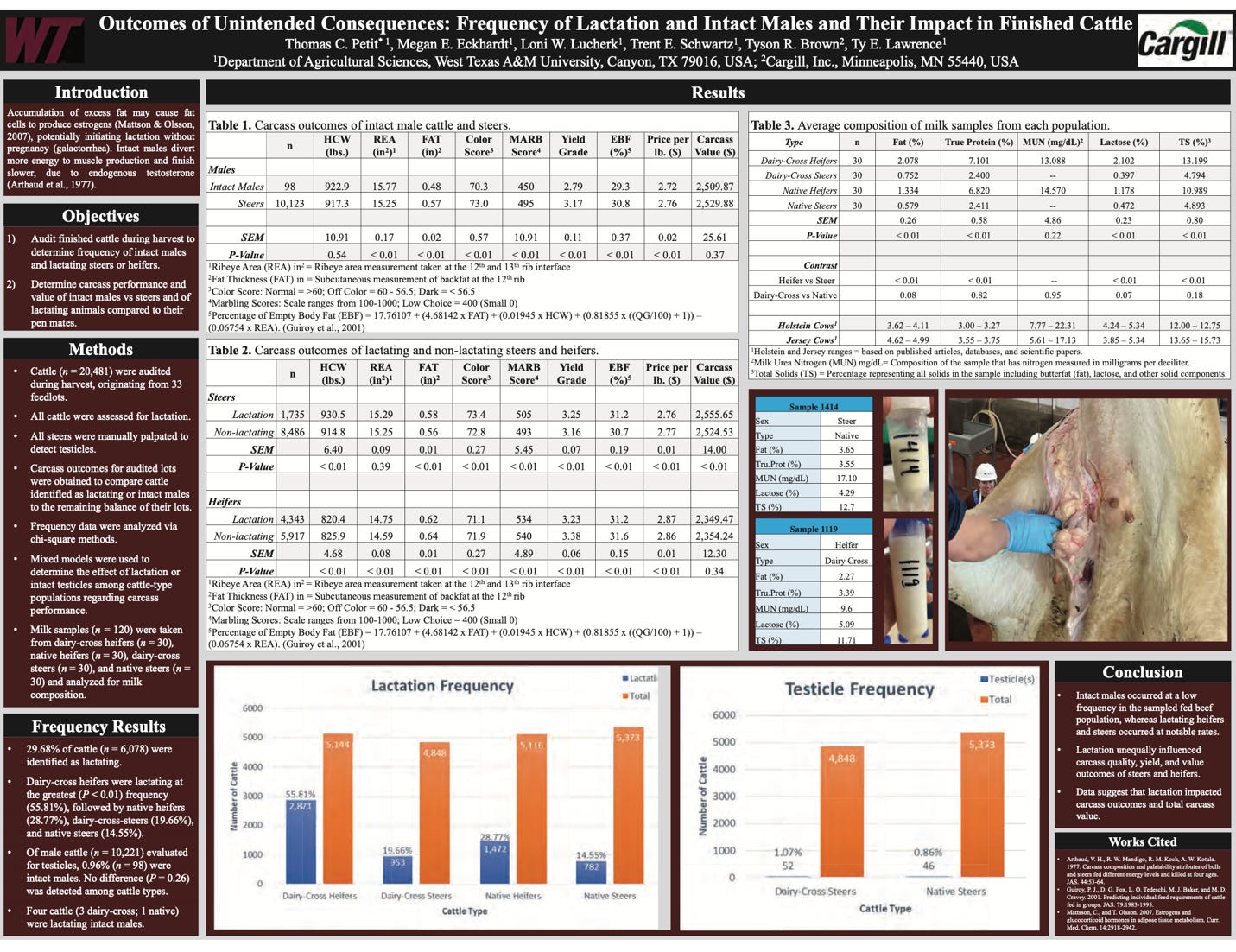
The researchers evaluated 17,507 finished cattle from 32 feedlots, including 8,693 male cattle.

And here’s what they found:

16.85% of dairy-cross steers and 14.61% of native steers were lactating.

Yes, male cattle from both groups were producing mammary secretions that the researchers classified as lactation.
The 2025 Study

A year later, they expanded their dataset by looking at more cattle, and presented “Outcomes of Unintended Consequences: Frequency of Lactation and Intact Males and Their Impact in Finished Cattle.”

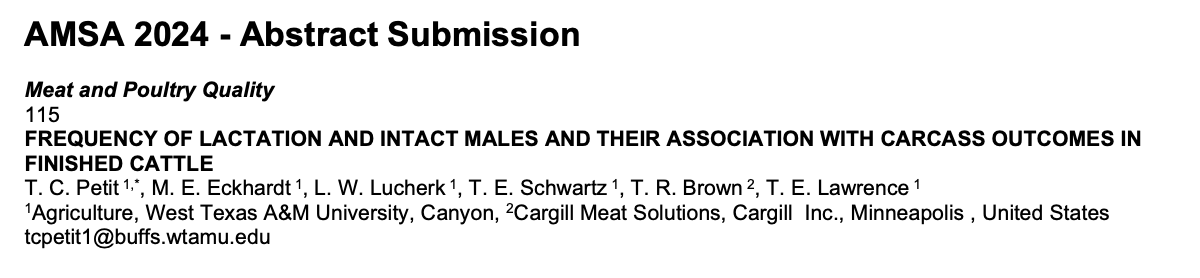
This time, they evaluated 20,481 cattle from 33 feedlots.

And once again, they found lactating males.

19.66% of dairy-cross steers and 14.55% of native steers were lactating.

When all of the male cattle in the 2025 study were considered together, about 17% were lactating.

That’s roughly 1 in 6 male cattle.

And among the dairy-cross males specifically, it was nearly 1 in 5.

Yikes.
But was it actually milk?

This is an important question because I’ve already had people respond to my posts on X suggesting that the researchers merely observed some sort of abnormal white liquid discharge and incorrectly called it lactation.

The researchers went further than simply observing fluid coming from the animals’ teats.

They collected 120 milk samples, including 30 from dairy-cross steers and 30 from native steers, and analyzed their composition.

The samples from the male cattle contained fat, true protein, lactose, and total solids.

The composition was different from normal Holstein or Jersey milk from female cattle with lower levels of lactose and fat, but the researchers themselves classified these animals as lactating steers and described what they collected as milk samples.

So yes, this was milk coming from male cattle teats.

Which leads us to the obvious question:

Why are so many male cattle lactating?!?!

The researchers did not establish the cause, but they did raise one possibility:

Excess body fat.

Their hypothesis was that excessive fat accumulation could increase internal estrogen production and contribute to milk production without pregnancy.

And interestingly, the lactating steers in their research had greater measures of body fat than the non-lactating steers.

Because fat isn’t simply inert storage. It is hormonally active tissue that contains an enzyme called aromatase that can convert androgens into estrogens.

Meaning greater amounts of body fat can provide greater capacity for estrogen production.

And that’s just the estrogenic influence coming from inside the animal.

Now let’s look at what’s coming from the outside and what I believe may be increasing the overall estrogenic load and feminizing male cattle in the modern feedlot system.

So why is this happening?

When you zoom out and look at how conventional beef cattle are raised, there are a lot of potential estrogenic and hormonally active exposures.

It makes sense to me to think about this using the concept of a “stress bucket.”

You may have heard this analogy before: everyone has a certain amount of stress they can handle before their bucket overflows. And everyone’s bucket starts at a different level depending on their biology, diet, lifestyle, environment, and everything else they’re being exposed to.

What if we thought about estrogenic exposure in cattle the same way?

There may not be one single compound responsible for what researchers are observing. Instead, these animals can encounter multiple sources of estrogenic or hormonally active compounds at the same time, and the combination will differ from animal to animal and feedlot to feedlot.

I think of it as their “estrogen bucket.”

Each exposure potentially adds a little more to the bucket. And at some point, maybe that bucket tips...

with white milk.

This is my framework for thinking about the different hormonal influences these animals can experience simultaneously, and why I think the cumulative environment deserves a much closer look.

And this matters because estrogen is intimately involved in mammary-gland development and works alongside hormones like prolactin to regulate the machinery required for lactation.

So disrupting normal estrogen signaling can potentially contribute to abnormal mammary development and milk production.

Here are some of the potential contributors to that “estrogen bucket”:

  • - Endogenous estrogen production associated with excess body fat, the possibility raised by the researchers themselves

  • - Hormonal growth promotants, including compounds with estrogenic activity such as zeranol

  • - Estrogenic mycotoxins, such as zearalenone, contaminating corn and other feed ingredients

  • - Phytoestrogens from feed ingredients such as soy and, in some rations, flax

  • - Agricultural and pest-control chemicals encountered through feed and the feedlot environment, some of which are known endocrine disruptors

Could some animals’ “estrogen buckets” be filling higher than others? Could multiple exposures interact? And could that help explain why some males lactated while others didn’t?

We don’t know. But considering researchers are now documenting lactation in male cattle, I think those are questions worth asking.

So let’s dive into what’s actually going into the bucket.

Growth-promoting hormones

The first is the most obvious since this involves direct hormone application.

In the United States, steroid hormones are not approved as growth promotants in pigs or poultry, but they are approved and commonly used in beef cattle.

The FDA currently approves six hormonal compounds for growth promotion in beef cattle:

  • - Naturally occurring hormones: estradiol, progesterone, and testosterone

  • - Synthetic compounds: trenbolone acetate (TBA), zeranol, and melengestrol acetate (MGA)

Most are administered through small implants placed under the skin of the ear, where the hormone compounds are slowly released over time.

Some of these compounds have raised concerns beyond the United States. For example, zeranol, a synthetic estrogenic growth promoter, is FDA-approved for use in US cattle but banned in the European Union due to concerns about hormonal activity, potential links to hormone-sensitive cancers, and broader endocrine-disrupting effects (ref, ref).

And these hormones aren’t being given because the animal is deficient in hormones or because it’s sick. They’re being used to make cattle grow faster, ultimately lowering the cost of producing beef.

But hormone implants aren’t the only potential source of estrogenic activity.

There can also be estrogenic compounds in what these cattle eat every single day.

Estrogenic mold toxins in feed

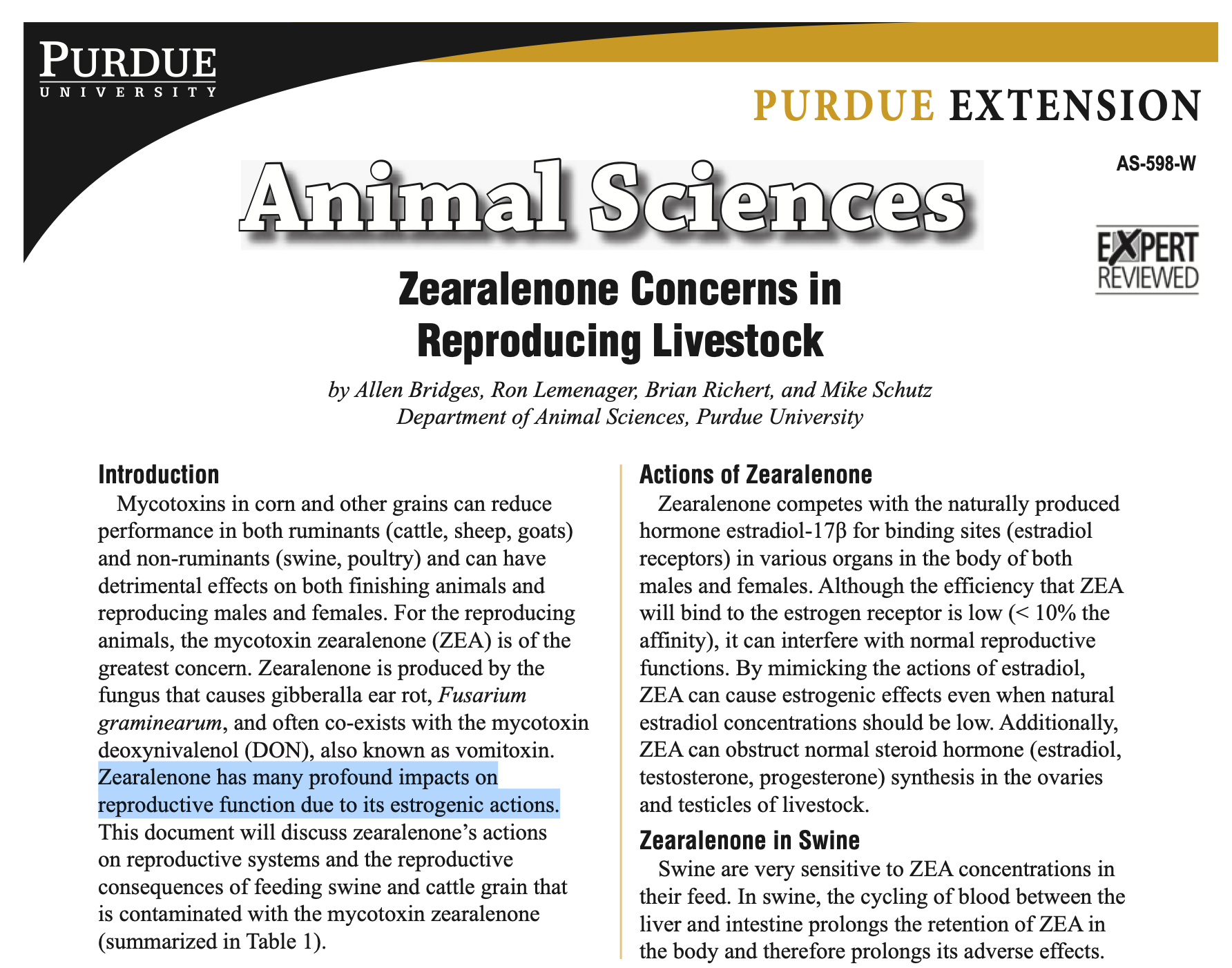
Feed introduces another potential source of estrogenic activity that most people have probably never heard about: mycotoxins. A mycotoxin is simply a toxic compound produced by certain molds. One particular mycotoxin example extremely relevant to this estrogen conversation is zearalenone.

Zearalenone is produced primarily by Fusarium molds and has well known estrogenic activity because its structure resembles estradiol. (ref) Zearalenone and its metabolites can bind to estrogen receptors and interfere with normal reproductive signaling.

In livestock, zearalenone exposure has been associated with reproductive abnormalities, and NC State notes that exposure can cause mammary-gland enlargement in virgin heifers. (ref)
So how are beef cattle encountering it?

Through their feed.

And this is where I think we need to take a pause and remember just how dramatically we’ve changed the way cattle are raised.

We took a grazing ruminant that historically lived primarily on grasses and other forage, moved it into a high-density finishing system, and replaced much of that forage with concentrated energy from mass-produced grain (largely GMO corn and corn byproducts).

Today, these energy-dense ingredients make up a substantial portion of many feedlot feed rations.

And producing, processing, transporting, and storing feed grains on this enormous scale creates opportunities for fungal contamination.

Corn can become infected with Fusarium and contaminated with zearalenone in the field, around harvest, or during storage. Importantly, the grain doesn’t even have to look visibly moldy for estrogenic mycotoxins to be present.

And this isn’t some obscure hypothetical exposure. This is well documented.

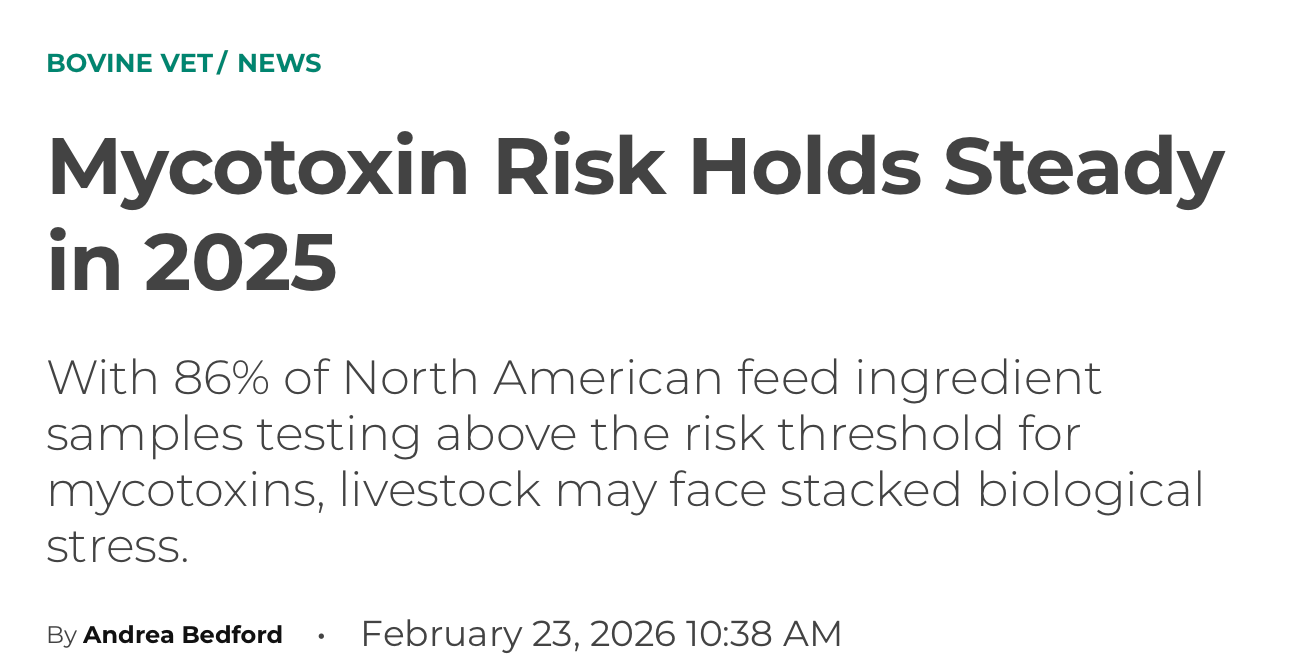
A recent study (ref) of complete beef-feedlot diets detected zearalenone in nearly 80% of the rations tested, and at least one mycotoxin in 100% of the samples. That study was conducted in Brazil, so we can’t assume the same prevalence applies to American feedlots. But a 2024 meta-analysis of 97 studies estimated a 70% global prevalence of zearalenone in bovine feed components (ref), and U.S. surveys have also documented zearalenone in corn grain and corn silage used as livestock feed.

More recent North American industry surveillance (ref) continues to detect zearalenone frequently, although we appear to lack a recent nationally representative study specifically testing complete U.S. beef-feedlot rations.

It’s also worth remembering that the U.S. beef supply isn’t exclusively domestic. The United States imports substantial quantities of beef from other countries, including major South American producers, which ultimately enter the U.S. food supply.
And there’s another reason the feedlot system makes the mycotoxin exposure particularly interesting: distillers grains.

Distillers grains are a co-product of ethanol production and have become a commonly used high-protein, high-energy ingredient in beef cattle diets.

Here’s why they’re relevant to mycotoxins.

Corn is made up of starch, protein, fat, fiber, and other components. When corn is fermented to produce ethanol (for alcohol and ‘clean energy’), much of its starch is removed and converted into ethanol and carbon dioxide.

But mycotoxins such as zearalenone don’t disappear with the removal of the starch component. Instead, the remaining nutrients, Omega 6 fats and any mycotoxins present in the original corn become concentrated in the resulting distillers grains (ref) which is then fed to cattle.

Research and extension guidance commonly describe mycotoxin concentrations in distillers grains as potentially reaching approximately three times the concentration present in the original corn. (ref, ref)

So, if we start with corn that already contains zearalenone. We remove a huge portion of that corn’s mass as starch during ethanol production...and the zearalenone can remain behind in a more concentrated cattle-feed ingredient.
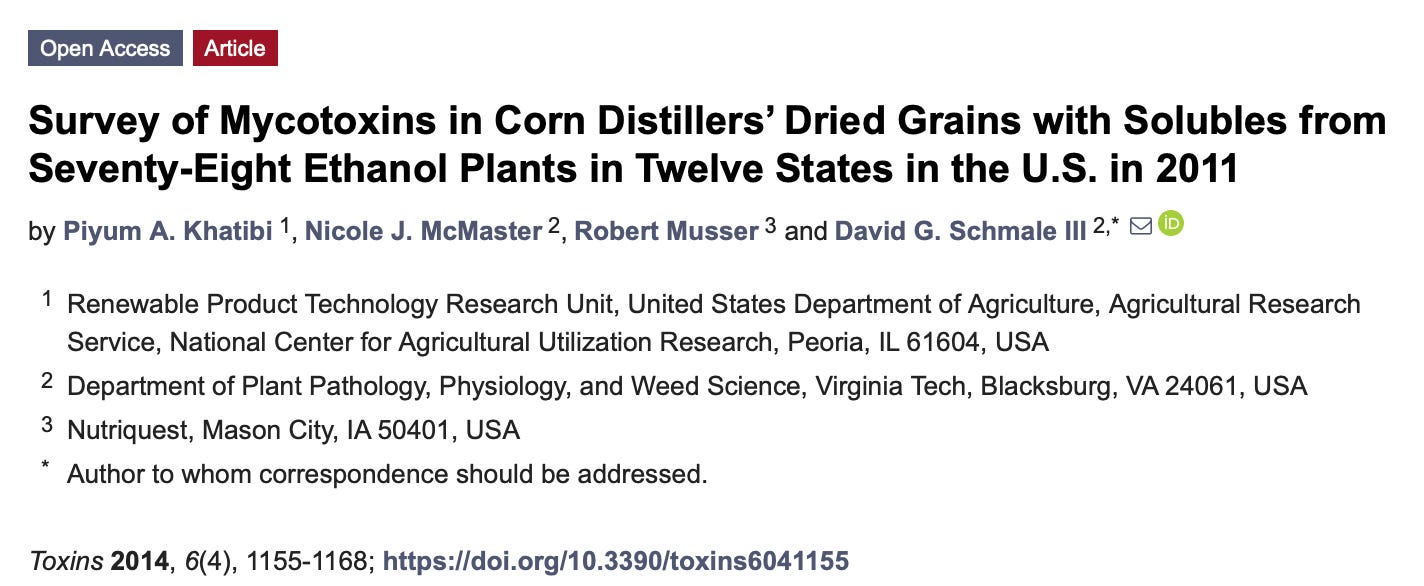
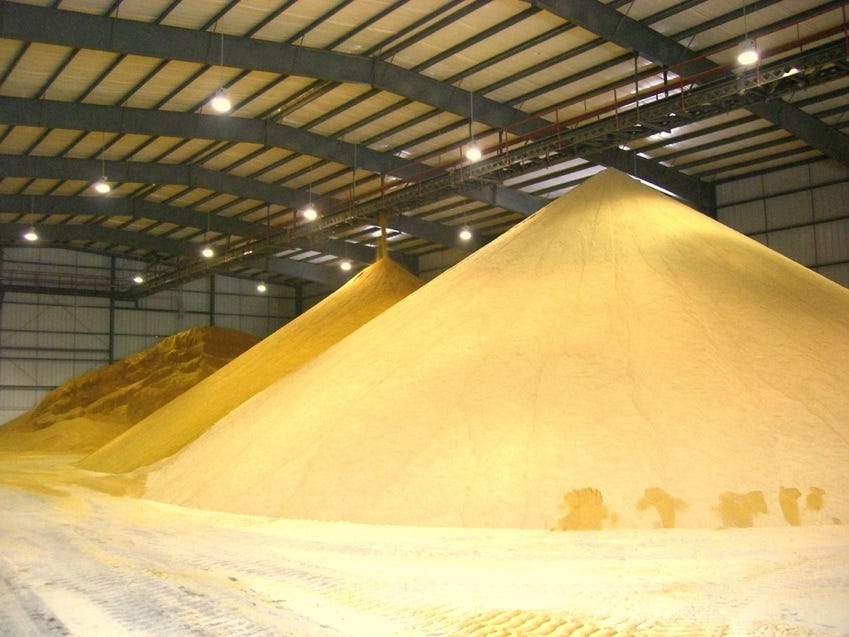
I am not saying every load of distillers grains is contaminated or unsafe. But this just illustrates another potential pathway through which feedlot cattle can encounter an estrogenically active compound in their daily diet.

And mycotoxins aren’t the only hormonally active compounds that can come through feed…

There are also phytoestrogens

Depending on the feed ration, cattle also commonly receive soy-derived ingredients in their feed. And now flax is being added in some specialty feeds due to recent trend of trying to lower saturated fats and increase PUFAs in ruminant fats due to the fear mongering of saturated fats that still somehow persists today. (ref)

While soy and flax are high in plant-based PUFAs, they are also the highest sources of phytoestrogens.

Phytoestrogens are naturally occurring plant compounds that can interact with estrogen receptors and influence estrogen signaling in animals.

Soy is particularly rich in the isoflavones genistein and daidzein, while flaxseed is especially rich in a different class of phytoestrogens called lignans.

When these ingredients are incorporated into cattle feed, we’re introducing yet another source of hormonally active compounds into the animal’s diet.
Studies confirm that soy phytoestrogens don’t simply pass harmlessly through cattle. When cattle are fed soy or soybean meal, researchers have detected increased levels of isoflavones and their metabolites in circulation and have documented changes in reproductive and endocrine signaling, including effects on prostaglandin signaling and steroidogenic activity in reproductive tissues. (ref, ref)

Similarly with flax, studies in cattle have shown that flax lignans are metabolized by the animal into compounds such as enterolactone and enterodiol, which are absorbed into circulation and can interact with estrogen signaling. Researchers have specifically investigated their effects on estradiol and estrogen-receptor activity in cattle. (ref)

So both soy and flax can introduce biologically active phytoestrogens into cattle, not merely compounds that appear in the feed, but compounds that are absorbed, metabolized, and capable of influencing hormonal signaling and adding to the cumulative estrogenic load.

And then we get to pesticides

More than 90% of the corn and soybeans grown in the United States are genetically engineered varieties, with herbicide tolerance among the dominant traits. These crops are specifically designed to tolerate herbicides such as glyphosate, glufosinate, or dicamba during production.

GMO Roundup Ready y’all!

And allowable pesticide residues on certain livestock feed crops are significantly higher than what’s allowed on food intended for direct human consumption. (ref)

Some pesticides are well known endocrine disruptors, even the EPA admits that. (ref)

So their feed ration can contain a nice coating of endocrine-disrupting pesticides.

But cattle aren’t only encountering pesticides through their feed.

Feedlots also have to manage flies, lice, mites, ticks, and other pests attracted to these unnatural, high-density environments.

Pestsicides can be sprayed in the environment, applied directly to cattle through sprays, pour-ons, dusts and insecticide ear tags, and some are even incorporated into feed. (ref) Common active ingredients include organophosphates such as tetrachlorvinphos and coumaphos, pyrethroids such as permethrin, and insect-growth regulators such as methoprene and diflubenzuron.

And pesticides don’t just vanish after application. Many of these compounds are fat-soluble. This means when animals consume pesticide-laden feed or are exposed environmentally, the chemicals accumulate in their fat, organs, and milk. (r) increasing the cumulative estrogen load over time.

Now Let’s Zoom Back Out

I don’t think there is one chemical responsible for lactating male cattle.

But remember the “estrogen bucket.” These animals are being exposed to multiple estrogenic influences at once, all potentially adding to that bucket. As that cumulative load builds, normal endocrine signaling can be disrupted, and lactation in male cattle may be one glaring sign of a system that has pushed that bucket too far.

  • - Excess body fat.

  • - Hormonal growth promotants.

  • - Phytoestrogens.

  • - Estrogenic mycotoxins.

  • - Agricultural pesticides used in growing their feed.

  • - Pest-control pesticides and chemicals used in and around the feedlot.

And that’s before we’ve even gotten into the other pharmaceuticals used in conventional cattle production.

Modern science is pretty good at evaluating compounds one at a time.

But an animal doesn’t experience its environment one compound at a time.

It experiences the entire system.

And when researchers find 17% of the male cattle they examined were lactating, maybe that’s a sign we need to start asking some serious questions about the environment we’re raising these animals in.

Because is this really the system you want producing your food?

Here’s my unpopular opinion.

It’s easy to point the finger at farmers, feedlots, pharmaceutical companies, or the beef industry…

But consumer demand helped build this system.

Americans expect beef to be abundant, heavily marbled, and cheap.

And producing enormous quantities of beef while keeping prices low creates tremendous pressure to maximize efficiency, accelerate growth, and drive down the cost of production.

  • - Energy-dense grain finishing.

  • - Growth-promoting hormones.

  • - Feed additives.

  • - Pest-control chemicals.

  • - Pharmaceutical interventions.

  • - High-density feedlots.

These aren’t a collection of random decisions. They’re pieces of a production model optimized for scale, speed, consistency, and cost.

And we helped create the market for it.

So What Do We Do?

Consumer demand helped shape this system, which means consumer demand can also help shape a different one.

Every dollar spent on food is a vote for what kind of agriculture we want more of.

If we demand the cheapest possible beef without asking how it was produced, the market will continue finding ways to produce beef as cheaply and efficiently as possible.

But if we’re willing to pay farmers to raise cattle differently, we create an economic incentive for a different production model.

  • One built around pasture and forage instead of maximizing grain intake.

  • One where animals have room to move and express their natural behaviors.

  • One that doesn’t depend on hormonal growth promotants to push weight gain.

  • One that avoids chemical and pharmaceutical interventions rather than designing a system around them.

  • And one where you can actually know how your food was produced.

If you knew the entire system behind the beef on your plate, would you still choose to buy it?

And if the answer is no, choose a different system.

Opt Out

You don’t have to fix the conventional food system. You can opt out of it.

That’s what we’re building at Nourish Food Club: an alternative food system centered around small regenerative farms and food you can trust. 

Our cattle are raised the old-fashioned way: 100% grass-fed and grass-finished on pasture, without grain finishing or hormonal growth promotants.

No male lactation 😂

And it doesn’t stop with beef. We offer 100% grass-fed beef and lamb, raw A2 dairy, corn- & soy-free eggs, chicken and pork, bone broth, pesticide-free produce, and more.

Old-fashioned food. Modern convenience. Delivered right to your door.

We do the driving, sourcing, and vetting so you don’t have to.

Ashley Armstrong

Latest Articles

Summer Soups: Why Traditional Cultures Ate Soup Year-Round

Summer Soups: Why Traditional Cultures Ate Soup Year-Round

Apparently people think it’s weird to eat soup in the summer. I used to think so too, until I realized that our whole concept of “soup season” is a pretty...

Summer Soups: Why Traditional Cultures Ate Soup Year-Round

Apparently people think it’s weird to eat soup in the summer. I used to think so too, until I realized that our whole concept of “soup season” is a pretty...

Angel Acres Eggs Tested Drug Free

Angel Acres Eggs Tested Drug Free

If you go out of your way to avoid pharmaceutical drugs in your own life… have you ever thought about whether pharmaceutical drugs were used to raise the animals producing...

Angel Acres Eggs Tested Drug Free

If you go out of your way to avoid pharmaceutical drugs in your own life… have you ever thought about whether pharmaceutical drugs were used to raise the animals producing...

how to not burn

What to Eat for Sun Protection: 5 Science-Backed Ways to Build Healthier Skin

Skin cancer rates are on the rise. Yet humans have lived under the sun for our entire history. And compared to previous generations, many people spend more time indoors than...

What to Eat for Sun Protection: 5 Science-Backed Ways to Build Healthier Skin

Skin cancer rates are on the rise. Yet humans have lived under the sun for our entire history. And compared to previous generations, many people spend more time indoors than...

What the 19 Million Egg Recall and Diarrhea Lettuce Outbreak Reveal About America’s Food System

What the 19 Million Egg Recall and Diarrhea Lettuce Outbreak Reveal About America’s Food System

Last week we exposed Big Pork. This week…Meet Big Egg 🥚and Big Lettuce. 🥬 The recent nationwide Salmonella egg recall and multistate diarrhea lettuce outbreak may seem like unrelated events....

What the 19 Million Egg Recall and Diarrhea Lettuce Outbreak Reveal About America’s Food System

Last week we exposed Big Pork. This week…Meet Big Egg 🥚and Big Lettuce. 🥬 The recent nationwide Salmonella egg recall and multistate diarrhea lettuce outbreak may seem like unrelated events....

China Owns Your Pork? Inside America’s Consolidated Pork Industry

China Owns Your Pork? Inside America’s Consolidated Pork Industry

There are consequences to decisions. Somewhere over the last 100 years, we decided that food should be produced as cheaply as possible. Farming shifted from thousands of independent family farms...

China Owns Your Pork? Inside America’s Consolidated Pork Industry

There are consequences to decisions. Somewhere over the last 100 years, we decided that food should be produced as cheaply as possible. Farming shifted from thousands of independent family farms...

Cyclospora Outbreak: What This Produce Recall Actually Tells Us About Our Food System

Cyclospora Outbreak: What This Produce Recall Actually Tells Us About Our Food System

You’ve probably seen the headlines about the recent Cyclospora outbreak linked to fresh produce.  Unfortunately, thousands of people have gotten sick with severe diarrhea, nausea and bloating. While I’ll briefly...

Cyclospora Outbreak: What This Produce Recall Actually Tells Us About Our Food System

You’ve probably seen the headlines about the recent Cyclospora outbreak linked to fresh produce.  Unfortunately, thousands of people have gotten sick with severe diarrhea, nausea and bloating. While I’ll briefly...

Oxalate-containing foods including potatoes, spinach, berries, and calcium-rich dairy foods that may reduce oxalate absorption

Should You Really Be Afraid of Oxalates?

Oxalates are one of the newest villains in the nutrition world. I know because I used to be afraid of them too. Several years ago, I avoided potatoes because I...

Should You Really Be Afraid of Oxalates?

Oxalates are one of the newest villains in the nutrition world. I know because I used to be afraid of them too. Several years ago, I avoided potatoes because I...

Seasonal Eating Benefits: Why Eating In-Season Produce May Improve Health

Seasonal Eating Benefits: Why Eating In-Season Produce May Improve Health

Have you ever noticed how a perfectly ripe summer peach tastes completely different than one bought in the middle of winter? Or how the first strawberries of the season seem...

Seasonal Eating Benefits: Why Eating In-Season Produce May Improve Health

Have you ever noticed how a perfectly ripe summer peach tastes completely different than one bought in the middle of winter? Or how the first strawberries of the season seem...

Can Seed Oils Increase Sunburn Risk? How Dietary Fats Affect Skin Health and Sun Exposure

Can Seed Oils Increase Sunburn Risk? How Dietary Fats Affect Skin Health and Sun Exposure

For decades, we’ve been taught to fear the sun: cover up, avoid midday light, and rely heavily on sunscreen for protection. But the sun itself is not the enemy. Sun...

Can Seed Oils Increase Sunburn Risk? How Dietary Fats Affect Skin Health and Sun Exposure

For decades, we’ve been taught to fear the sun: cover up, avoid midday light, and rely heavily on sunscreen for protection. But the sun itself is not the enemy. Sun...

Eggshell toothpaste

Homemade Eggshell Toothpaste: A Simple Way to Reuse Your Eggshells

Learn how to make homemade eggshell toothpaste using finely ground eggshell powder, coconut oil, and a few simple ingredients. A practical, low-waste way to reuse leftover eggshells instead of throwing...

Homemade Eggshell Toothpaste: A Simple Way to Reuse Your Eggshells

Learn how to make homemade eggshell toothpaste using finely ground eggshell powder, coconut oil, and a few simple ingredients. A practical, low-waste way to reuse leftover eggshells instead of throwing...

Symptoms Are Not the Enemy

Symptoms Are Not the Enemy

Guest Contributor: Dr. Alex Orton, ND at havenholistichealth.com ------------------------------------------------------------------------------------ There's only one disease. This is the cure. You have been at war with your body for your whole life. Well,...

Symptoms Are Not the Enemy

Guest Contributor: Dr. Alex Orton, ND at havenholistichealth.com ------------------------------------------------------------------------------------ There's only one disease. This is the cure. You have been at war with your body for your whole life. Well,...

What to Do With Eggshells: 7 Simple Ways to Use Them (Instead of Throwing Them Away)

What to Do With Eggshells: 7 Simple Ways to Use Them (Instead of Throwing Them Away)

If you go through a lot of eggs each week, you’ve probably wondered what to do with all those leftover shells. Instead of throwing them away, here are simple, practical...

What to Do With Eggshells: 7 Simple Ways to Use Them (Instead of Throwing Them Away)

If you go through a lot of eggs each week, you’ve probably wondered what to do with all those leftover shells. Instead of throwing them away, here are simple, practical...

How Livestock Drug Use Impacts Human Health, Antibiotic Resistance, and the Environment

How Livestock Drug Use Impacts Human Health, Antibiotic Resistance, and the Environment

This is Part 3 of a deep dive into drug use in conventional animal agriculture. So far, we’ve covered how these drugs became embedded in the system, and what happens...

How Livestock Drug Use Impacts Human Health, Antibiotic Resistance, and the Environment

This is Part 3 of a deep dive into drug use in conventional animal agriculture. So far, we’ve covered how these drugs became embedded in the system, and what happens...

Do Drug Residues End Up in Meat, Milk, and Eggs? Understanding MRLs and Food Testing Gaps

Do Drug Residues End Up in Meat, Milk, and Eggs? Understanding MRLs and Food Testing Gaps

In Part 1, we broke down how drug use has become a routine part of conventional meat production, and why the system depends on it. But that understanding naturally leads...

Do Drug Residues End Up in Meat, Milk, and Eggs? Understanding MRLs and Food Testing Gaps

In Part 1, we broke down how drug use has become a routine part of conventional meat production, and why the system depends on it. But that understanding naturally leads...

Drug Use in Livestock: Why Antibiotics and Other Drugs Are Used in Modern Animal Agriculture

Drug Use in Livestock: Why Antibiotics and Other Drugs Are Used in Modern Animal Agriculture

Drugs are used extensively in today’s conventional livestock production systems From chickens and pigs raised in confinement operations (CAFOs), to beef and dairy cattle in feedlots, to even conventional honeybee...

Drug Use in Livestock: Why Antibiotics and Other Drugs Are Used in Modern Animal Agriculture

Drugs are used extensively in today’s conventional livestock production systems From chickens and pigs raised in confinement operations (CAFOs), to beef and dairy cattle in feedlots, to even conventional honeybee...

brown vs white eggs

Are Brown Eggs Healthier Than White Eggs? 🥚 The Truth About Egg Color

Are brown eggs healthier than white? Uncover the truth about egg color, nutrition, and flavor at Nourish Food Club | Join us for insights!

Are Brown Eggs Healthier Than White Eggs? 🥚 The Truth About Egg Color

Are brown eggs healthier than white? Uncover the truth about egg color, nutrition, and flavor at Nourish Food Club | Join us for insights!

Why Is Sourdough Bread Good For You Benefits Explained

Why Is Sourdough Bread Good For You?

Learn if is sourdough bread good for you with Nourish Food Club covering fermentation, flour quality, digestion, and metabolic impact.

Why Is Sourdough Bread Good For You?

Learn if is sourdough bread good for you with Nourish Food Club covering fermentation, flour quality, digestion, and metabolic impact.

Many Pesticides Were Never Properly Tested by the Government

Many Pesticides Were Never Properly Tested by the Government

Nearly 30 years after a federal mandate, many pesticides still haven’t been properly tested for their effects on human endocrine health. --------------------------------------------------- Cheap food production in the modern conventional system...

Many Pesticides Were Never Properly Tested by the Government

Nearly 30 years after a federal mandate, many pesticides still haven’t been properly tested for their effects on human endocrine health. --------------------------------------------------- Cheap food production in the modern conventional system...

The Health Effects of Pesticides: What Chronic Exposure Does to Your Body

The Health Effects of Pesticides: What Chronic Exposure Does to Your Body

It’s naïve to assume that chemicals specifically designed to disrupt biological systems out on fields come without consequences for our own biology. When we attempt to control nature through chemistry,...

The Health Effects of Pesticides: What Chronic Exposure Does to Your Body

It’s naïve to assume that chemicals specifically designed to disrupt biological systems out on fields come without consequences for our own biology. When we attempt to control nature through chemistry,...

Pesticide-Coated Seeds: The Hidden Source of Chemical Exposure in Food

Pesticide-Coated Seeds: The Hidden Source of Chemical Exposure in Food

Key Points: > Many modern crop seeds are coated with pesticides before planting > This “upstream” pesticide use is largely untracked and not regulated > Seed coatings often contain multiple...

Pesticide-Coated Seeds: The Hidden Source of Chemical Exposure in Food

Key Points: > Many modern crop seeds are coated with pesticides before planting > This “upstream” pesticide use is largely untracked and not regulated > Seed coatings often contain multiple...

Does GMO Wheat Exist? Not Yet. But Soon.

Does GMO Wheat Exist? Not Yet. But Soon.

GMO wheat isn’t yet grown in the US, but it was approved for use in 2024 so its just a matter of time before yet another toxic ingredient is added...

Does GMO Wheat Exist? Not Yet. But Soon.

GMO wheat isn’t yet grown in the US, but it was approved for use in 2024 so its just a matter of time before yet another toxic ingredient is added...

Glyphosate Resistance Is Growing, and Here Comes Glufosinate

Glyphosate Resistance Is Growing, and Here Comes Glufosinate

Glyphosate now has a backup partner in crime. Meet glufosinate. Both glyphosate and glufosinate are broad-spectrum herbicides, meaning they’re designed to kill almost any plant they touch. They’re not selective,...

Glyphosate Resistance Is Growing, and Here Comes Glufosinate

Glyphosate now has a backup partner in crime. Meet glufosinate. Both glyphosate and glufosinate are broad-spectrum herbicides, meaning they’re designed to kill almost any plant they touch. They’re not selective,...

Why Folic Acid Is Added to Flour (And the Health Concerns)

Why Folic Acid Is Added to Flour (And the Health Concerns)

Most people have no idea that nearly every loaf of bread, tortilla, muffin, or bagel they buy contains added synthetic folic acid. While this government policy may have started with...

Why Folic Acid Is Added to Flour (And the Health Concerns)

Most people have no idea that nearly every loaf of bread, tortilla, muffin, or bagel they buy contains added synthetic folic acid. While this government policy may have started with...

Stop Chasing Protocols: The Foundations First Approach to Health

Stop Chasing Protocols: The Foundations First Approach to Health

Guest Contributor: Dr. Alex Orton, ND at havenholistichealth.com ------------------------------------------------------------ Most alternative health approaches are dead ends. Functional medicine. Biohacking. Esoteric protocols on internet forums. On paper, these approaches look good....

Stop Chasing Protocols: The Foundations First Approach to Health

Guest Contributor: Dr. Alex Orton, ND at havenholistichealth.com ------------------------------------------------------------ Most alternative health approaches are dead ends. Functional medicine. Biohacking. Esoteric protocols on internet forums. On paper, these approaches look good....

Iron-Fortified Flour: The Hidden Health Risks of Synthetic Iron in Enriched Wheat

Iron-Fortified Flour: The Hidden Health Risks of Synthetic Iron in Enriched Wheat

Once a nutrient-rich dietary staple, bread today can make many people feel unwell. While several factors may contribute (including pesticide residues like glyphosate, seed oils, and preservatives), one rarely discussed...

Iron-Fortified Flour: The Hidden Health Risks of Synthetic Iron in Enriched Wheat

Once a nutrient-rich dietary staple, bread today can make many people feel unwell. While several factors may contribute (including pesticide residues like glyphosate, seed oils, and preservatives), one rarely discussed...

Healthiest Way To Eat Eggs And Cook Them Well

Healthiest Way To Eat Eggs: Best Cooking Methods + What to Avoid

Learn the healthiest way to eat eggs, including cooking methods to use and what to avoid. Nourish Food Club explains how preparation affects egg quality.

Healthiest Way To Eat Eggs: Best Cooking Methods + What to Avoid

Learn the healthiest way to eat eggs, including cooking methods to use and what to avoid. Nourish Food Club explains how preparation affects egg quality.

Heritage Wheat Benefits, Nutrition & Key Differences

Heritage Wheat: Benefits, Nutrition And How It Compares To Modern Wheat

Explore heritage wheat nutrition, benefits, and how it compares to modern wheat. Nourish Food Club breaks down flavor, fiber, digestibility, and the value of ancient grains.

Heritage Wheat: Benefits, Nutrition And How It Compares To Modern Wheat

Explore heritage wheat nutrition, benefits, and how it compares to modern wheat. Nourish Food Club breaks down flavor, fiber, digestibility, and the value of ancient grains.

Is Sourdough Bread Healthy? 8 Science-Backed Benefits of Traditional Sourdough

Is Sourdough Bread Healthy? 8 Science-Backed Benefits of Traditional Sourdough

Sourdough is all the rave right now, but what does it actually mean, and why do so many people say they digest it better than modern bread? A deep dive...

Is Sourdough Bread Healthy? 8 Science-Backed Benefits of Traditional Sourdough

Sourdough is all the rave right now, but what does it actually mean, and why do so many people say they digest it better than modern bread? A deep dive...

How to Spot Fake Sourdough: The 3 Types of Sourdough Explained

How to Spot Fake Sourdough: The 3 Types of Sourdough Explained

Not all sourdough is created equal. And truthfully, most of the sourdough in the US is fake. That’s because in the US, the word “sourdough” has no legal definition. That...

How to Spot Fake Sourdough: The 3 Types of Sourdough Explained

Not all sourdough is created equal. And truthfully, most of the sourdough in the US is fake. That’s because in the US, the word “sourdough” has no legal definition. That...

Example Day of Eating: How to Hit Your RDAs Through Whole Foods (No Supplements Required)

Example Day of Eating: How to Hit Your RDAs Through Whole Foods (No Supplements Required)

If metabolism matters, micronutrients matter. In the last post, we covered why vitamins and minerals are not optional extras, they are required for your body to convert your food into...

Example Day of Eating: How to Hit Your RDAs Through Whole Foods (No Supplements Required)

If metabolism matters, micronutrients matter. In the last post, we covered why vitamins and minerals are not optional extras, they are required for your body to convert your food into...

How to Meet Your Vitamin and Mineral Needs Through Food (Not Supplements)

How to Meet Your Vitamin and Mineral Needs Through Food (Not Supplements)

People talk a lot about avoiding toxins these days, and rightfully so. Compounds that interfere with the body’s normal processes can absolutely impair health. But there’s another widespread issue we...

How to Meet Your Vitamin and Mineral Needs Through Food (Not Supplements)

People talk a lot about avoiding toxins these days, and rightfully so. Compounds that interfere with the body’s normal processes can absolutely impair health. But there’s another widespread issue we...

Naturally Multi-Colored Eggs Placed On The Ground

Pasture-Raised Eggs Meaning: Labels, Standards, And How To Choose The Best

Learn what pasture-raised eggs really mean, how labels fall short, why feed matters, and how to choose eggs with real transparency.

Pasture-Raised Eggs Meaning: Labels, Standards, And How To Choose The Best

Learn what pasture-raised eggs really mean, how labels fall short, why feed matters, and how to choose eggs with real transparency.

Person Prepping Meal With Eggs, Lemon, Avocado, Olives, and Salt

What Are Corn And Soy Free Eggs? Benefits, Taste, And What To Look For

Find out what corn and soy free eggs mean, why they matter for your health, and how to choose truly clean, healthy eggs for your family.

What Are Corn And Soy Free Eggs? Benefits, Taste, And What To Look For

Find out what corn and soy free eggs mean, why they matter for your health, and how to choose truly clean, healthy eggs for your family.

How to Create Your Own Perfect Personal Diet (And Stop Dieting Forever)

How to Create Your Own Perfect Personal Diet (And Stop Dieting Forever)

Guest Contributor: Dr. Alex Orton, ND This guest blog post was written by Dr. Alex Orton, a naturopathic doctor with over 10 years of experience in holistic health. Dr. Orton...

How to Create Your Own Perfect Personal Diet (And Stop Dieting Forever)

Guest Contributor: Dr. Alex Orton, ND This guest blog post was written by Dr. Alex Orton, a naturopathic doctor with over 10 years of experience in holistic health. Dr. Orton...

Breakfast plate of high-pufa eggs and sausage.

PUFAs Explained: Understanding Fats In The Modern Diet

Learn what PUFAs are, how they affect your health, and why low-PUFA foods matter. Find clean, low PUFA food choices at Nourish Food Club.

PUFAs Explained: Understanding Fats In The Modern Diet

Learn what PUFAs are, how they affect your health, and why low-PUFA foods matter. Find clean, low PUFA food choices at Nourish Food Club.

The “Vital Farms Egg Scandal” Isn’t a Scandal, It’s a Wake-Up Call

The “Vital Farms Egg Scandal” Isn’t a Scandal, It’s a Wake-Up Call

The so-called “Vital Farms Egg Scandal” has opened many people’s eyes to a reality that’s been hiding in plain sight: the modern food system is built on corn and soy...

The “Vital Farms Egg Scandal” Isn’t a Scandal, It’s a Wake-Up Call

The so-called “Vital Farms Egg Scandal” has opened many people’s eyes to a reality that’s been hiding in plain sight: the modern food system is built on corn and soy...

Is Linoleic Acid Really Essential? (an Omega 6 PUFA)

Is Linoleic Acid Really Essential? (an Omega 6 PUFA)

We’re often told certain nutrition “truths” as one-line headlines, without ever being encouraged to ask why. One examples is: “Linoleic acid is an essential fatty acid.” But what does essential actually mean?...

Is Linoleic Acid Really Essential? (an Omega 6 PUFA)

We’re often told certain nutrition “truths” as one-line headlines, without ever being encouraged to ask why. One examples is: “Linoleic acid is an essential fatty acid.” But what does essential actually mean?...

How Polyunsaturated Fats (PUFAs) Impair Metabolism and Energy Production

How Polyunsaturated Fats (PUFAs) Impair Metabolism and Energy Production

Together let's understand why the PUFAs in seed oils (and high intakes of conventional pork/chicken/eggs) can change how your body makes energy. The first thing to understand is that not...

How Polyunsaturated Fats (PUFAs) Impair Metabolism and Energy Production

Together let's understand why the PUFAs in seed oils (and high intakes of conventional pork/chicken/eggs) can change how your body makes energy. The first thing to understand is that not...

Glycine: The Anti-Inflammatory Amino Acid Most Diets Are Missing

Glycine: The Anti-Inflammatory Amino Acid Most Diets Are Missing

Most conversations about inflammation focus on "antioxidants", supplements, or eliminating entire food groups.Far less attention is paid to the signaling role of amino acids, particularly glycine, one of the most metabolically important...

Glycine: The Anti-Inflammatory Amino Acid Most Diets Are Missing

Most conversations about inflammation focus on "antioxidants", supplements, or eliminating entire food groups.Far less attention is paid to the signaling role of amino acids, particularly glycine, one of the most metabolically important...

Saturated Fat Was Never the Villain: Why Cholesterol Became the Wrong Target

Saturated Fat Was Never the Villain: Why Cholesterol Became the Wrong Target

We were told saturated fats were the bad guys, and that “heart-healthy” polyunsaturated fats would save us. But that story was wrong. New research (and the re-analysis of old research)...

Saturated Fat Was Never the Villain: Why Cholesterol Became the Wrong Target

We were told saturated fats were the bad guys, and that “heart-healthy” polyunsaturated fats would save us. But that story was wrong. New research (and the re-analysis of old research)...

Are Pasture-Raised Eggs Better? What the Label Really Means

Are Pasture-Raised Eggs Better? What the Label Really Means

When you hear the term “pasture-raised,” what do you picture? Hens roaming freely on green grass. Sunshine. Fresh air. Bugs and plants. A natural life that produces a better egg. But...

Are Pasture-Raised Eggs Better? What the Label Really Means

When you hear the term “pasture-raised,” what do you picture? Hens roaming freely on green grass. Sunshine. Fresh air. Bugs and plants. A natural life that produces a better egg. But...

The Unintended Consequences of Clean Energy on Your Nutrition

The Unintended Consequences of Clean Energy on Your Nutrition

Is “Clean Energy” Quietly PUFA-ing Our Food? Most people know why seed oils are a problem. They’re extremely high in the unstable polyunsaturated fat linoleic acid, an omega-6 that slows...

The Unintended Consequences of Clean Energy on Your Nutrition

Is “Clean Energy” Quietly PUFA-ing Our Food? Most people know why seed oils are a problem. They’re extremely high in the unstable polyunsaturated fat linoleic acid, an omega-6 that slows...

is flour bad for you

Is Flour Bad for You? The Truth About Modern, Processed Wheat

You hear it everywhere today: “bread is bad,” “flour is unhealthy,” “gluten is toxic.” And now every recipe on the internet seems to be flour-free or gluten-free. Okay… but what...

Is Flour Bad for You? The Truth About Modern, Processed Wheat

You hear it everywhere today: “bread is bad,” “flour is unhealthy,” “gluten is toxic.” And now every recipe on the internet seems to be flour-free or gluten-free. Okay… but what...

How to use Ancient Grains and Heritage Wheat

How to use Ancient Grains and Heritage Wheat

Flour used to be a staple in our ancestors’ diets. But over time, three major food system shifts have changed it dramatically: Modern wheat has been hybridized to maximize yield,...

How to use Ancient Grains and Heritage Wheat

Flour used to be a staple in our ancestors’ diets. But over time, three major food system shifts have changed it dramatically: Modern wheat has been hybridized to maximize yield,...

When Regenerative Agriculture Goes Industrial, And Why We Said No

When Regenerative Agriculture Goes Industrial, And Why We Said No

Lately, I’ve been reflecting on how much the pasture-raised and regenerative agriculture movement has grown, and that’s something to celebrate! More people than ever are asking questions about where their...

When Regenerative Agriculture Goes Industrial, And Why We Said No

Lately, I’ve been reflecting on how much the pasture-raised and regenerative agriculture movement has grown, and that’s something to celebrate! More people than ever are asking questions about where their...

How Linoleic Acid and Oxidized Fats Fuel Headaches

How Linoleic Acid and Oxidized Fats Fuel Headaches

There are many reasons headaches happen: muscle tension from stress, dehydration or electrolyte imbalance, even eye strain from screens. But one major factor is often overlooked: the types of fats in...

How Linoleic Acid and Oxidized Fats Fuel Headaches

There are many reasons headaches happen: muscle tension from stress, dehydration or electrolyte imbalance, even eye strain from screens. But one major factor is often overlooked: the types of fats in...

healthiest way to cook eggs

The Healthiest Way to Cook Eggs: Tips for Maximum Nutrition

Did you know that how you cook your eggs can impact how much nutrition your body actually absorbs? Eggs are nature’s perfect food, but the method you choose can make...

The Healthiest Way to Cook Eggs: Tips for Maximum Nutrition

Did you know that how you cook your eggs can impact how much nutrition your body actually absorbs? Eggs are nature’s perfect food, but the method you choose can make...

Grass-Fed vs. Grain-Fed Beef: The Metabolic Health Difference You Can See and Taste

Grass-Fed vs. Grain-Fed Beef: The Metabolic Health Difference You Can See and Taste

Grain-fed cattle raised in feedlots aren’t just fatter… they show the same metabolic warning signs we associate with diabetes in humans. In fact: the way a cow lives (what it...

Grass-Fed vs. Grain-Fed Beef: The Metabolic Health Difference You Can See and Taste

Grain-fed cattle raised in feedlots aren’t just fatter… they show the same metabolic warning signs we associate with diabetes in humans. In fact: the way a cow lives (what it...

The Truth About Lab-Made Meat (and Why Regenerative Farming Is Better)

The Truth About Lab-Made Meat (and Why Regenerative Farming Is Better)

Lab-made meat is being hailed as the future of food. Influencers are calling it more ethical, more sustainable, and better for the planet. But step back for a moment. Do...

The Truth About Lab-Made Meat (and Why Regenerative Farming Is Better)

Lab-made meat is being hailed as the future of food. Influencers are calling it more ethical, more sustainable, and better for the planet. But step back for a moment. Do...